Introduction
Rational numbers are numbers that can be written as a fraction where the top and bottom are whole numbers. In this lesson, we will learn how to add, subtract, multiply, and divide these numbers. Think of rational numbers like sharing pieces of a pizza fairly with your friends!
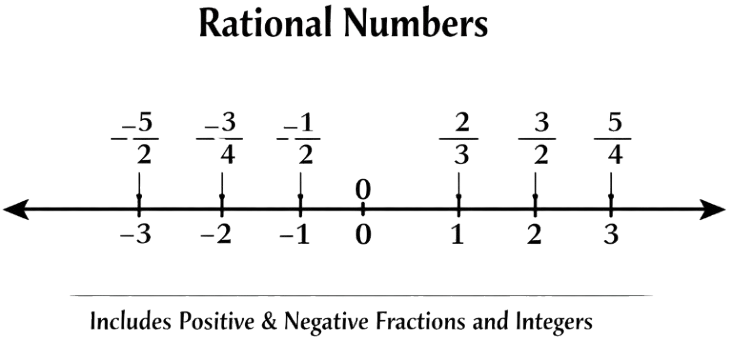
A number line displaying how rational numbers include positive and negative fractions and integers.
Concept Explanation
A rational number is any number that can be expressed in the form p/q, where p and q are integers and q is not zero. This includes natural numbers, whole numbers, and integers. When we perform operations, we must ensure the denominators are the same for addition and subtraction.
Sub-topics
Rational numbers and operations on rational numbers
Operations on rational numbers follow the same rules as fractions. To add or subtract, find a common denominator. For multiplication, multiply the numerators and denominators directly.
Examples
Example 1: Addition
Example 2: Solving for x
Tricks and Shortcuts
To divide two rational numbers, simply multiply the first number by the reciprocal (flip) of the second number.
If you have an equation like (a/b) . x = c/d, simply multiply both sides by the reciprocal b/a to find x in one step!
Common Mistakes
Students often forget to change the denominator before adding. Remember, you cannot add 1/2 + 1/4 to get 2/6!
Practice Questions
Easy Questions
- Add the rational numbers: 2/5 + 1/5.
- Identify if 7 is a rational number.
- Solve: 2x = 1/2.
Medium Questions
- Subtract 1/4 from 3/8.
- Divide 5/6 by 2/3.
- Solve: (3/4). m = 9/8.
Hard Questions
- Simplify: (1/2 + 1/3) x 6/5.
- Find three rational numbers between 1/3 and 1/2.
- Solve: (1/2).x + (1/3).x = 5/6.
Revision Summary
Rational numbers include integers and fractions. Always find a common denominator for addition and subtraction. For division, use the "flip and multiply" rule.
Always perform the same operation on both sides of the equation. Use LCM to clear fractions for easier calculations.