📢
Number Work - Natural numbers, whole numbers, integer rational numbers, irrational numbers, real numbers
Introduction
Numbers are the building blocks of mathematics. They are categorized into different sets based on their properties, starting from basic counting to complex calculations on a number line.
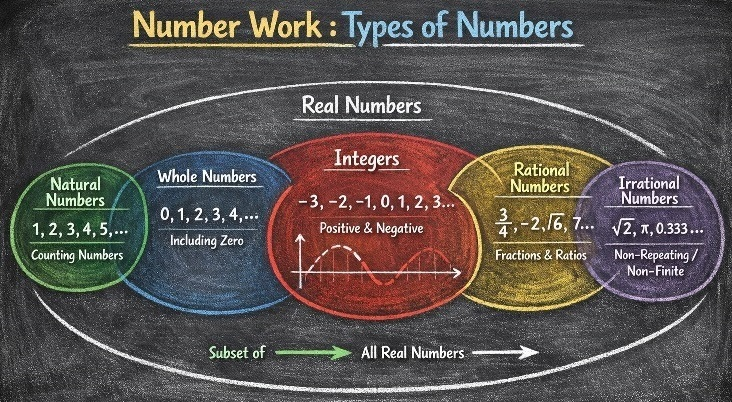
Explanation Step by Step
Understanding the hierarchy of the number system is crucial for solving algebraic problems.
Sub-topics
Number Types and Descriptions
Each number type serves a specific mathematical purpose:
- Natural Numbers: Counting numbers starting from 1. (Ex: 1, 2, 3, 50)
- Whole Numbers: Includes all natural numbers and zero. (Ex: 0, 1, 2, 10)
- Integers: Includes positive numbers, negative numbers, and zero. (Ex: -4, -1, 0, 5)
- Rational Numbers: Numbers that can be written as a fraction p/q. (Ex: 3/4, -2/5, 7)
- Irrational Numbers: Numbers that cannot be expressed as simple fractions. (Ex: √2, π, √5)
- Real Numbers: The set of all rational and irrational numbers. (Ex: -1, 0.5, √3)
Examples
Example 1
Identify the type of 0.75.
Answer: 0.75 is a Rational Number and a Real Number.
Tricks and Shortcuts
Think of the number system as nested boxes: Natural numbers inside Whole numbers, inside Integers, inside Rational numbers.
Common Mistakes
Do not assume all square roots are irrational. For example, √16 = 4, which is a rational number.
Practice Questions
Easy Questions
- State the smallest whole number.
- Is -12 a natural number?
- True or False: All natural numbers are also integers.
Medium Questions
- Identify a number that is an integer but not a whole number.
- Why is 22/7 considered a rational number?
- If 'n' is a natural number, is 'n + 1' always a natural number?
Hard Questions
- Determine whether (√2 × √2) results in a rational or irrational number.
- Find a number that is a real number but not a rational number.
- If x < 0 and x is an integer, what is the largest possible value for x?
Revision Summary
The number system consists of Natural, Whole, Integers, Rational, Irrational, and Real numbers, each building upon the previous set.
Given two rational numbers x, y.
x + y = 1, x × y = 1/6
Which of the following is the value of x − y = ?
x + y = 1, x × y = 1/6
Which of the following is the value of x − y = ?
A
1/2
B
1/3
C
1/6
D
√(1/3)
If x = p/q (Rational) and y = √2 (Irrational), which of the following mathematical operations always results in a rational number?
A
x + y
B
x × y
C
x ÷ y
D
x − x