Introduction
Number work involves categorizing numbers based on their properties. Understanding Even, Odd, Prime, Composite, Twin Prime, and Co-prime numbers is essential for solving complex mathematical problems and identifying patterns.
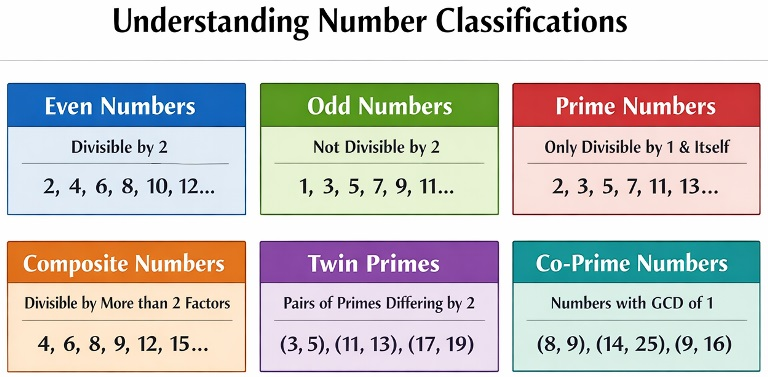
Overview of number types and their definitions
Explanation Step by Step
Each number type is defined by how it reacts to division and its relationship with other numbers. Let's look at each type with specific examples to clarify the concept.
Sub-topics
Number Work - Types and Examples
Here is a detailed breakdown of different number categories:
- Even Numbers: Numbers exactly divisible by 2. Example: 10, 24, 56.
- Odd Numbers: Numbers not exactly divisible by 2. Example: 11, 23, 45.
- Prime Numbers: Numbers having only two factors: 1 and the number itself. Example: 2, 13, 19.
- Composite Numbers: Numbers having more than two factors. Example: 4, 9, 15.
- Twin Prime Numbers: Pairs of prime numbers with a difference of 2. Example: (11, 13), (17, 19).
- Co-prime Numbers: Numbers that have only 1 as a common factor. Example: (8, 15), (4, 9).
Examples
Example 1
Example 2: Multiplication Rules
Example 3: Consecutive Primes
Tricks and Shortcuts
To identify an even number instantly, check the last digit; it must be 0, 2, 4, 6, or 8. All other numbers are odd.
To check if two numbers are co-prime quickly, check if they are consecutive (like 14 and 15). Consecutive integers are always co-prime!
Common Mistakes
Do not assume all odd numbers are prime. For example, 9 and 15 are odd but they are composite numbers.
Students often think the sum of two prime numbers is always even. However, 2 + 3 = 5, which is odd!
Practice Questions
Easy Questions
- Is 37 a prime number or a composite number?
- Write any three even numbers greater than 50.
- What is the smallest composite number?
- If k = 5, is 2k - 1 even or odd?
Medium Questions
- Identify the co-prime pair from (14, 21) and (14, 25).
- List all twin primes between 1 and 30.
- If x and y are both odd, is x * y even or odd?
- Find a pair of co-prime numbers where both numbers are composite.
Hard Questions
- Explain why (9, 10) are co-prime even though neither is a prime number.
- Prove that for any prime number p > 3, the number p^2 - 1 is always divisible by 24.
- If n is an even number, prove that n^2 is divisible by 4.
- Find the smallest number that has exactly 5 factors. (Hint: It's a square of a prime).
Revision Summary
Even and odd numbers focus on divisibility by 2. Prime and composite numbers focus on the total number of factors. 1 is the only unique number that is neither prime nor composite.
Equations turn abstract number rules into concrete logic. Always test your rules with small numbers like 2 and 3 to verify them.
(i) Two consecutive odd numbers are always co-prime.
(ii) The product of two prime numbers is always a composite number.
(iii) There are a total of 6 pairs of twin prime numbers between 1 and 50.
Which of the above statements are true?