📢
Vocabulary - Writing contextual meanings of words
Introduction
Contextual meaning refers to the specific meaning of a word based on how it is used in a sentence. A single word can have different meanings depending on the surrounding words and the overall situation described. Understanding context helps us become better readers and communicators.
Explanation Step by Step
To find the contextual meaning of a word, follow these steps:
- Read the entire sentence carefully.
- Look for "clue words" around the unknown word.
- Identify the tone of the sentence (is it happy, sad, or serious?).
- Replace the word with a synonym to see if the sentence still makes sense.
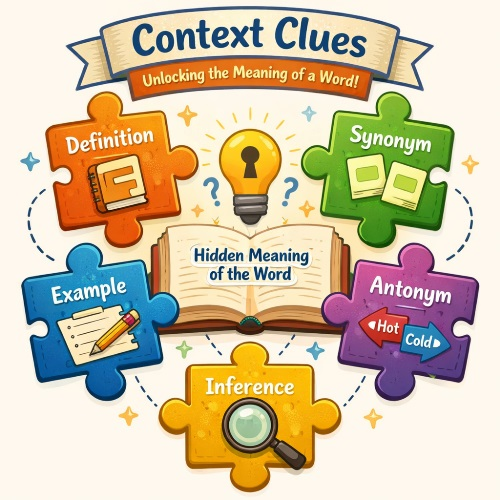
Sub-topics
Vocabulary - Writing contextual meanings of words
In this sub-topic, we focus on interpreting words that have multiple meanings (homonyms) or specific professional meanings within a real-life scenario.
Examples
Example 1 (Real-Life)
Sentence: "The bank of the river was muddy after the rain."
Meaning: Here, "bank" means the land alongside a body of water, not a place where you keep money.
Tricky Example (Conceptual)
Sentence: "The climate of the meeting was quite tense."
Meaning: In this context, "climate" refers to the atmosphere or mood of a social situation, rather than the weather or temperature.
Tricks and Shortcuts
- The Substitution Trick: Try putting a simple word in place of the hard word. If the sentence works, you've found the meaning!
- Positive/Negative Check: Determine if the word sounds like something good or bad based on the other words in the sentence.
Common Mistakes
- Dictionary Trap: Students often choose the first definition they see in a dictionary without checking if it fits the sentence.
- Ignoring Tone: Sometimes students miss the emotional context, leading to a wrong interpretation of the word.
Practice Questions
Easy Questions
- Real-Life: "The teacher told the students to park their bags in the corner." What does "park" mean here?
- "I need a second to finish my homework." Does "second" mean number 2 or a short amount of time?
- Tricky: "She wore a plain dress to the party." Does "plain" mean a flat land or something simple?
Medium Questions
- Real-Life: "After the long hike, my water bottle was deserted." What does "deserted" imply about the bottle?
- "The pitch of the singer's voice was incredibly high." Define "pitch" in this musical context.
- Tricky: "The company decided to plant a new office in the city." Does "plant" refer to a tree or establishing a business?
Hard Questions
- Real-Life: "The manager had to fire the employee for being late every day." What is the contextual meaning of "fire"?
- "The judge will fine the driver for breaking the traffic rule." What does "fine" mean in a legal sense?
- Tricky: "The content of the book made the reader feel very content." Explain the two different meanings and usages.
Revision Summary
Contextual meaning is all about being a detective. Don't look at a word in isolation; look at its neighbors. Remember to use the substitution trick and always check the tone of the sentence to ensure the meaning fits perfectly.
Meaning of match in: India won the cricket match.
A
A thin stick for lighting fire
B
To look similar to
C
A formal contest or game
D
A life partner
Contextual meaning: Close the tap after use.
A
To hit lightly
B
A device to control water flow
C
To listen secretly
D
A dance form