Introduction
Vocabulary is the foundation of any language. One of the most effective ways to build a strong vocabulary is by identifying words through descriptions or hints. This skill helps students improve their critical thinking and memory recall by connecting concepts to specific terms. Whether it is solving crosswords or identifying objects in real life, using clues to find the right word is a vital communication tool.
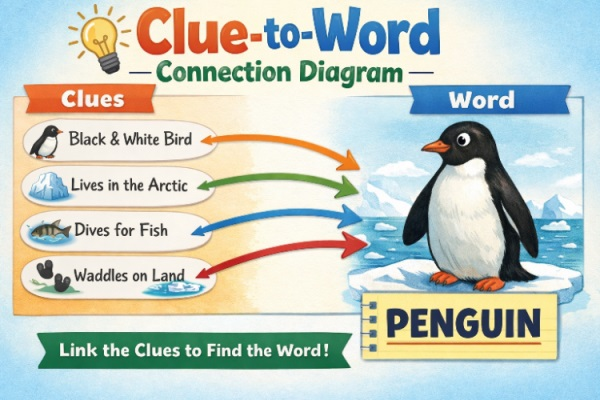
Explanation Step by Step
Writing words using given clues involves analyzing a description and finding the specific noun, verb, or adjective it refers to. Here is how to do it:
- Read the clue carefully and identify the "category" (Is it a person, place, or thing?).
- Look for keywords within the clue that describe a function or appearance.
- Match the clue to your existing word bank.
| Clue (Description) | Word | Meaning | Example Sentence |
|---|---|---|---|
| Something you read | Book | A set of written pages bound together | I borrowed a book from the library. |
| Something you write with | Pen | An instrument for writing with ink | She wrote a letter with a pen. |
| A place where students learn | School | An institution for educating children | We go to school every morning. |
| A person who teaches | Teacher | One who imparts knowledge | The teacher explained the lesson clearly. |
| A large body of water | Ocean | Vast expanse of salt water | The Pacific Ocean is very deep. |
| A device used to tell time | Clock | An instrument that shows hours and minutes | The clock struck twelve. |
| A person who writes stories | Author | Writer of books or articles | J.K. Rowling is the author of Harry Potter. |
| A building where books are kept | Library | A place to read and borrow books | The library has many reference books. |
| A person who studies | Student | Learner in school or college | Every student must complete homework. |
| A vehicle with two wheels | Bicycle | Transport powered by pedaling | He rides his bicycle to school. |
Sub-topics
Writing words using given clues
This sub-topic focuses on decoding descriptive sentences to arrive at a single, precise word. It often involves real-life scenarios like describing a profession, a household item, or a feeling.
Examples
Example 1 (Real-Life)
Example 2 (Tricky Example)
Tricks and Shortcuts
- Focus on the Verb: If the clue mentions an action (e.g., "to cut"), the word is likely a tool or a profession.
- First Letter Strategy: Sometimes the number of blanks or the context provides a hint for the starting letter.
Common Mistakes
- Being Too General: Writing "Food" when the clue specifically describes "Pizza." Always look for the most specific word.
- Ignoring Parts of Speech: Using a verb when the clue describes a person (e.g., writing "Teach" instead of "Teacher").
Practice Questions
Easy Questions
- A large animal with a trunk and big ears. (Direct)
- The place where you go to learn and study. (Real-Life)
- I am the color of the grass. What am I? (Tricky: Is it an object or just the color name?)
Medium Questions
- A period of 10 years. (Conceptual)
- A person who designs buildings and houses. (Real-Life)
- I follow you all day long, but when the sun goes away, I disappear. What am I? (Tricky Real-Life)
Hard Questions
- An imaginary line around the middle of the Earth. (Conceptual)
- The written list of food items available in a restaurant. (Real-Life)
- The more of this there is, the less you see. What is it? (Tricky Conceptual)
Revision Summary
Identifying words through clues strengthens your vocabulary. Always identify the main subject of the clue first. Practice regularly with riddles and word games to improve your speed and accuracy in word association.