Introduction
Area is the measure of how much space a flat shape occupies. From calculating the floor area for tiling to understanding the size of a playground, area is a vital part of geometry. It is measured in square units like sq. cm or sq. m. In this guide, we cover all major 2D shapes and their properties.
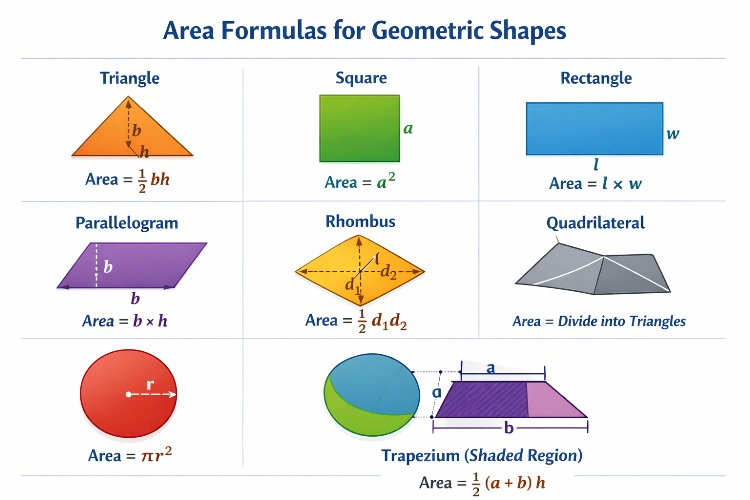
Visual Guide to Area Formulas for Various Geometric Shapes
Explanation Step by Step
Calculating area involves identifying the shape and using the correct formula. For regular shapes, we use standard dimensions like length, base, or radius. For complex or irregular figures, we decompose them into simpler shapes like rectangles or triangles to calculate the total space.
Sub-topics
1. Triangle
The space inside three connected sides. Formula: (1/2) * base * height.
Example
2. Square
A shape with four equal sides. Formula: side * side.
Tricky Example
3. Rectangle
Opposite sides are equal and parallel. Formula: length * width.
Real-life Example
4. Parallelogram
A quadrilateral with opposite sides parallel. Formula: base * height.
5. Rhombus
All sides are equal. Formula: (1/2) * diagonal1 * diagonal2.
6. Quadrilateral
Any four-sided figure. Area can be found by splitting it into two triangles using a diagonal.
7. Circle
A round figure. Formula: π * r2 (where π ≈ 22/7).
8. Irregular Figure
Figures without standard sides. Calculated by dividing them into known shapes like squares or triangles.
9. Shaded Portion
Finding the area of a specific part. Logic: Outer Area - Inner Area.
10. Trapezium
One pair of parallel sides. Formula: (1/2) * (sum \ of \ parallel \ sides) * height.
Tricks and Shortcuts
- To find the area of a Rhombus, if diagonals are given, don't find sides; use the diagonal formula directly.
- For shaded parts, always check if the inner shape is centered or touching the sides.
Common Mistakes
- Confusing radius with diameter. Always divide diameter by 2 before squaring.
- Using slant height instead of vertical height in triangles and parallelograms.
Practice Questions
Easy Questions
- Find the area of a square with side 12 cm.
- A rectangle has length 15 cm and width 6 cm. What is its area?
- Calculate area of a triangle with base 10 cm and height 7 cm. (Tricky: Is the height always inside the triangle?)
Medium Questions
- Find the area of a circle with a diameter of 14 cm.
- A parallelogram has a base of 8 cm and area 48 sq. cm. Find its height.
- Real-life: A wall is 4m x 3m. A window of 1m x 1m is in it. Find the area to be painted. (Tricky)
Hard Questions
- A trapezium has parallel sides of 10 cm and 20 cm. The height is 5 cm. Find its area.
- A wire 44 cm long is bent into a circle. Find its area. (Tricky: Use circumference to find radius first).
- Real-life: A circular garden has a 2m wide path around it. If the garden radius is 10m, find the area of the path.
Revision Summary
Area is the total surface covered. Remember: Square (S2), Rectangle (L * W), Triangle ((1/2) * B * H), Circle (πr2). Always verify units and look for hidden shapes in irregular figures.