Introduction
Everything we see around us, like a water bottle, a book, or a ball, occupies space and has three dimensions: length, width, and height. These are called 3D objects. In this lesson, we will learn about their surfaces (faces), edges (lines), and vertices (corners), and how they look when unfolded as a 'Net'.
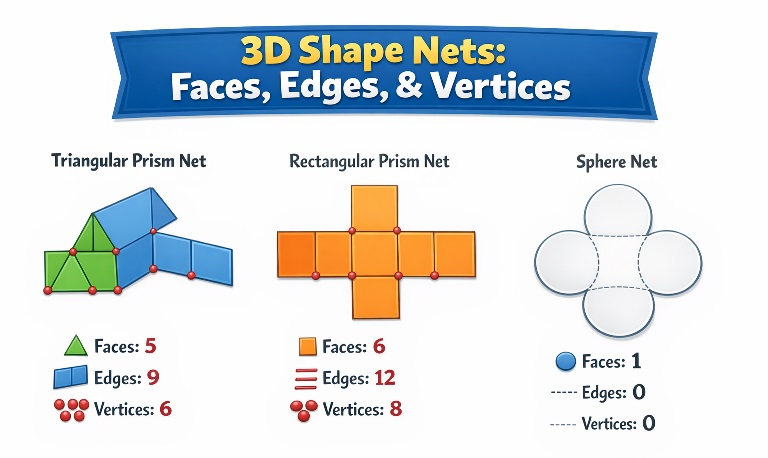
3D shapes are defined by their unique number of faces, edges, and vertices.
Explanation Step by Step
Every 3D object has specific characteristics:
- Face (Surface): The flat or curved part of the object.
- Edge: The line where two faces meet.
- Vertex: The point where three or more edges meet (the corner).
- Net: A 2D flat shape that can be folded to form a 3D object.
Sub-topics
1. Rectangular Prism (Cuboid)
A rectangular prism has 6 faces, all of which are rectangles. Think of a brick or a lunch box.
Examples
Example: The Geometry Box
Tricky Example (Real-life)
2. Triangular Prism
This shape has two triangular bases and three rectangular sides. It looks like a camping tent.
Examples
Example: The Tent Shape
3. Sphere
A sphere is perfectly round. Every point on its surface is the same distance from the center.
Examples
Example: The Cricket Ball
Tricks and Shortcuts
1. The Prism Edge Trick: For any prism, the number of edges is always 3 times the number of sides of its base (e.g., Triangle base 3 x 3 = 9 edges).
2. Euler’s Magic: For prisms, Faces + Vertices - Edges always equals 2.
Common Mistakes
1. Students often think a Sphere has 1 edge because they draw it as a circle. Remember, a sphere has 0 edges!
2. Forgetting hidden edges: When drawing a prism, always count the lines you can't see on the back side.
Practice Questions
Easy Questions
- How many vertices does a rectangular prism have?
- Real-life: Is an orange a sphere or a prism?
- Tricky: Can a flat piece of paper be a 3D object? (Yes, it has a tiny amount of height/thickness!)
Medium Questions
- A triangular prism has 5 faces. If 2 are triangles, what shape are the other 3?
- Real-life: If you unfold a cardboard juice carton, what is the resulting flat shape called?
- Tricky: If a shape has no vertices and no edges, what must it be?
Hard Questions
- If you join two cubes together face-to-face, how many faces does the new rectangular prism have?
- Real-life: You are building a tent with 3 rectangular fabric sheets and 2 triangular ones. How many poles (edges) do you need to hold it up?
- Tricky: Why can we not create a flat 'Net' for a perfect sphere without wrinkling the paper?
Revision Summary
3D objects have faces, edges, and vertices. Prisms are named after their bases (Rectangular or Triangular). Spheres have no corners. A Net is the 2D layout used to build these 3D shapes.
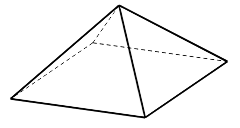
Identify the three-dimensional shape shown below.