Introduction
A quadrilateral is a closed flat shape with 4 straight sides, 4 vertices, and 4 angles. The word comes from 'quad' meaning four and 'lateral' meaning sides. Whether it is a square playground or a rectangular book, quadrilaterals are everywhere in our daily life. The most important rule to remember is that the sum of all internal angles in any quadrilateral is always 360 degrees.
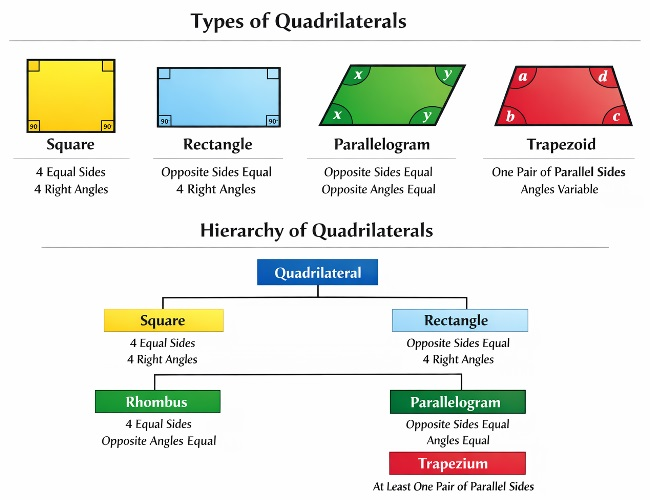
- Visual representation of different quadrilaterals and their internal angle sum of 360 degrees.
- A family tree of quadrilaterals showing how they relate based on side and angle properties.
Explanation Step by Step
To understand quadrilaterals, we look at their sides and angles. Imagine you have 4 matchsticks. If you join them end-to-end to close the shape, you have made a quadrilateral. If you make all sides equal and all angles 90 degrees, it becomes a square. If you push the corners of a rectangle, it tilts and becomes a parallelogram.
Sub-topics
Properties of Quadrilateral
Every quadrilateral has specific features: it has 2 diagonals that connect opposite corners. In special cases like rectangles, these diagonals are equal. In a parallelogram, opposite sides are parallel and equal.
Examples
Example 1: The Park Boundary
Tricky Example: The Slanted Fence
Classification of Quadrilaterals
There are six main types of quadrilaterals:
- Parallelogram: Opposite sides are parallel and equal.
- Rectangle: A parallelogram with four 90° angles.
- Square: A rectangle with all four sides equal.
- Rhombus: A parallelogram with all four sides equal (angles don't have to be 90°).
- Trapezium (Trapezoid): Only one pair of opposite sides is parallel.
- Kite: Two pairs of adjacent sides are equal.
Examples
Example 1: The Window Frame
Tricky Example: The Diamond Shape
Tricks and Shortcuts
- The 360 Rule: Always check if your four angles add up to 360. If they don't, it's not a quadrilateral!
- Z-Pattern: In parallelograms, look for the 'Z' shape to find equal alternate interior angles quickly.
- The Parent Rule: Remember that a Square is the most "special" — it inherits properties from the Rectangle, Rhombus, and Parallelogram.
- Parallel Check: If no sides are parallel, it’s just a "General Quadrilateral."
Common Mistakes
- Thinking all quadrilaterals have equal diagonals. (Only Rectangles and Squares do!)
- Confusing a Rhombus with a Square. (A Rhombus doesn't need to have 90-degree angles).
- Calling every four-sided shape a "Square."
- Thinking a Trapezium must have equal non-parallel sides (only an "Isosceles Trapezium" does).
Practice Questions
Easy Questions
- Find the fourth angle of a quadrilateral if three angles are 80, 100, and 70 degrees.
- True or False: A square is a special type of rectangle.
- Tricky Question: Can a quadrilateral have 4 acute angles (less than 90 degrees)? Explain why.
- Which quadrilateral has all four sides equal and all four angles equal to 90°?
- How many pairs of parallel sides does a Trapezium have?
- Tricky Question: Can a quadrilateral have 3 acute angles? (Hint: Think of the 360° sum).
Medium Questions
- In a parallelogram, one angle is 110 degrees. Find the measures of the remaining 3 angles.
- A kite-shaped kite has two angles of 115 degrees each. If the third angle is 50 degrees, find the fourth angle.
- Real-life Tricky Question: You are tiling a floor with identical diamond-shaped tiles (Rhombus). If one angle of the tile is 60 degrees, what are the other three angles?
- If a Parallelogram has all sides equal but no right angles, what is its specific name?
- Identify the shape: Adjacent sides are equal, but opposite sides are not.
- Real-life Tricky Question: You are looking at a roof section where the top and bottom edges are parallel, but the side edges lean inward equally. Name this specific quadrilateral.
Hard Questions
- The angles of a quadrilateral are in the ratio 2:3:4:6. Find the measure of each angle.
- In a trapezium ABCD, AB is parallel to DC. If Angle A = 55 degrees and Angle B = 70 degrees, find Angle C and Angle D.
- Conceptual Tricky Question: If the diagonals of a quadrilateral bisect each other at 90 degrees and are equal in length, prove which specific quadrilateral it is.
- Prove that the diagonals of a Square are equal and bisect each other at 90°.
- In an Isosceles Trapezium, if one base angle is 75°, find all other angles.
- Conceptual Tricky Question: "All rectangles are parallelograms, but all parallelograms are not rectangles." Explain why this statement is true.
Revision Summary
A quadrilateral is a 4-sided polygon. The sum of interior angles is always 360 degrees. Key types include Squares, Rectangles, Parallelograms, Rhombuses, and Trapeziums. Diagonals and parallel sides help distinguish between these shapes.
Quadrilaterals are grouped by their sides and angles. Parallelograms (Square, Rectangle, Rhombus) have two pairs of parallel sides. Trapeziums have one pair. Kites have equal adjacent sides. All share the 360° angle sum property.