Introduction
Triangles are fundamental polygons in geometry. Understanding their properties and the concept of congruence—where two shapes are identical in size and shape—is crucial for solving complex spatial problems.
Congruence Criteria
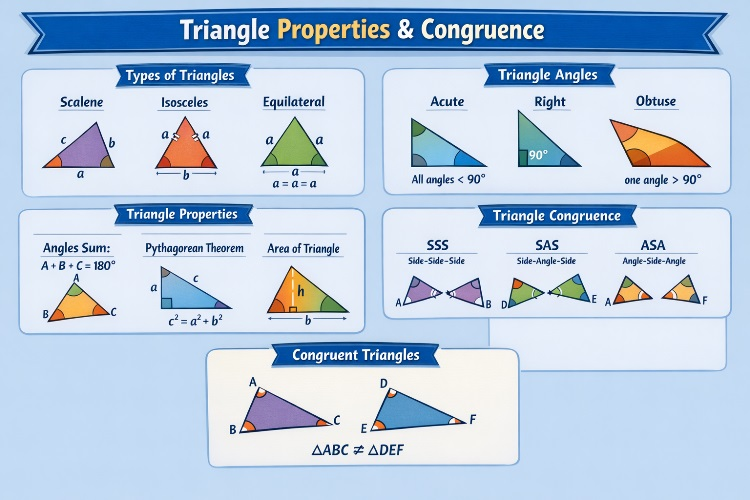
To prove two triangles are congruent, one of the following must be true:
- SSS (Side-Side-Side): All three sides of one triangle are equal to the three corresponding sides of another.
- SAS (Side-Angle-Side): Two sides and the included angle (the angle between them) are equal.
- ASA (Angle-Side-Angle): Two angles and the included side are equal.
- RHS (Right-Angle Hypotenuse Side): In two right-angled triangles, the hypotenuse and one side are equal.
Explanation Step by Step
1. Triangle Angle Sum: Sum of internal angles is always 180 degrees. 2. Triangle Inequality: Sum of any two sides must be greater than the third side. 3. Congruence: Proving two triangles are identical using criteria like SSS, SAS, ASA, or RHS.
Sub-topics
Geometry - Properties of triangle and congruence of the triangles
Properties include the sum of angles, types of triangles (Equilateral, Isosceles, Scalene), and the logic behind side-angle relationships.
Examples
Example 1 (Real-Life)
Tricky Example
Triangle Properties and Complex Proofs
Key properties include the Angle Sum Property (180°) and the Exterior Angle Property.
Examples
Tricky Example (Real-Life)
Example (Conceptual)
Tricks and Shortcuts
1. Remember "Order Matters": In SAS, the angle must be the "included" angle between the two sides.
2. For RHS, always identify the hypotenuse first; it's the side opposite to the 90-degree angle.
3. Always look for "Shared Sides" or "Vertically Opposite Angles" first; they are "free" information.
4. The "Included Angle" in SAS must be the one formed by the two sides being compared.
Common Mistakes
1. Assuming AAA (Angle-Angle-Angle) proves congruence. It only proves the triangles look the same (similarity), not that they are the same size.
2. Forgetting that the longest side of a triangle is always opposite the largest angle.
3. Confusing SSA (Side-Side-Angle) for a rule. SSA does not guarantee congruence unless it's a right triangle (RHS).
4. Ignoring the order of vertices. Triangle ABC is NOT always congruent to Triangle PQR just because they have the same numbers; matching parts must correspond.
Practice Questions
Easy Questions
- Find the third angle of a triangle if two angles are 50 and 70 degrees.
- State the congruence criteria if three sides of one triangle are equal to three sides of another.
- (Real-life) Can you create a triangular frame with sticks of length 1 cm, 2 cm, and 4 cm? (Tricky)
- If two angles of a triangle are 60° and 60°, find the third angle.
- What is the name of the rule where three sides of one triangle equal three sides of another?
- (Real-life) Can you build a triangle with sides of 2 cm, 2 cm, and 5 cm? Explain.
Medium Questions
- In triangles ABC and DEF, AB=DE, BC=EF, and AC=DF. Name the congruence rule.
- (Real-life) Two identical flags are made. If their base and height are the same, are they congruent?
- If an isosceles triangle has a vertex angle of 100 degrees, find the base angles. (Tricky)
- In an isosceles triangle, if the base angles are 50° each, find the vertex angle.
- (Real-life) Two identical ladder supports are built. Each has a 5-meter side and a 3-meter base with a 90° angle between them. Are they congruent?
- (Tricky) If Triangle ABC ≅ Triangle FED, which side of FED corresponds to side BC?
Hard Questions
- Prove why SSA (Side-Side-Angle) is not a valid congruence criterion.
- (Real-life) A carpenter makes two triangular roof trusses. If the angles are the same but one uses 10-foot beams and the other 12-foot beams, are they congruent?
- If triangle ABC is congruent to triangle PQR, and the perimeter of ABC is 24 cm, what is the perimeter of PQR? Explain why. (Tricky)
- (Real-life) Two triangular bridge trusses are made. Truss A has angles 30°, 60°, 90° and a hypotenuse of 10m. Truss B has a base of 5m, a hypotenuse of 10m, and a 90° angle. Are they congruent? Prove using the correct rule.
- Prove that the diagonal of a rectangle divides it into two congruent triangles using the RHS criterion.
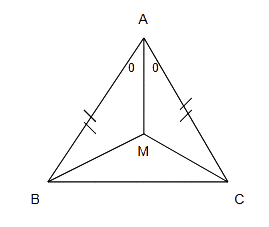
- (Tricky) Triangle PQR has PQ=PR. A point M is the midpoint of QR. Prove that Triangle PQM ≅ Triangle PRM and identify all 3 matching pairs of parts.
Revision Summary
Triangles must have an angle sum of 180. Congruence means "exactly the same." Use SSS, SAS, ASA, or RHS to prove it. Always check the triangle inequality rule!
Congruence means identical in every way. Remember SSS, SAS, ASA, and RHS. AAA and SSA are traps—do not use them for congruence!