Introduction
Geometry revolves around shapes, and the circle is one of the most perfect ones. It is defined as the set of all points in a plane that are equidistant from a fixed center point.
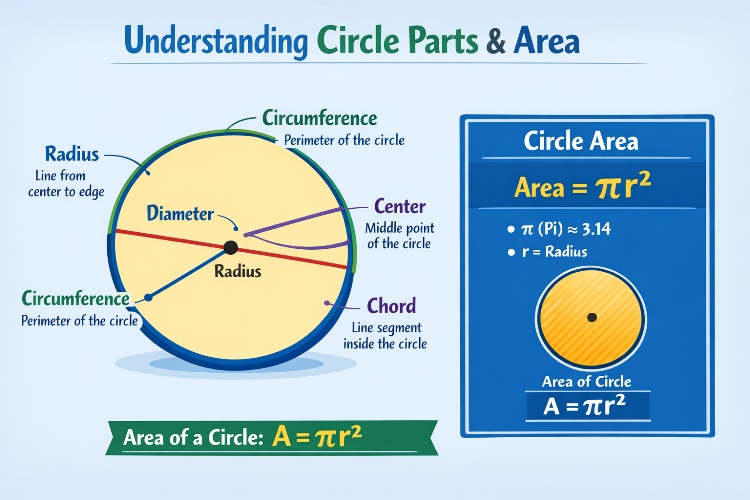
A visual guide to understanding Circle parts and its Area.
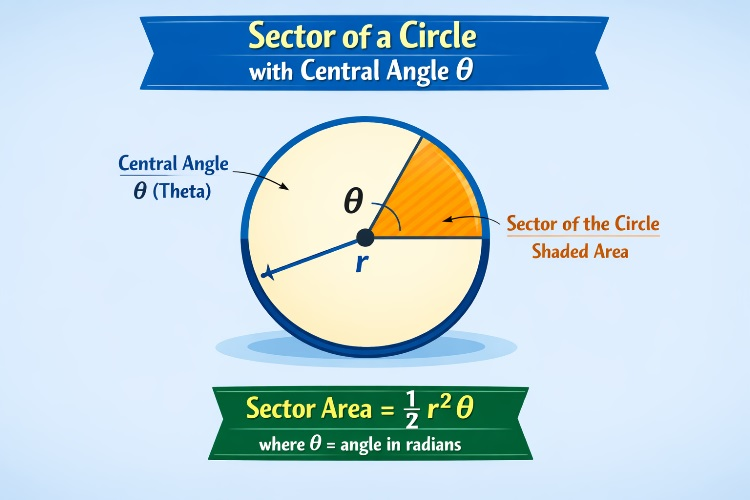
Understanding the Central Angle (θ) and its related Sector.
Explanation Step by Step
A "Sector" is a portion of a circle bounded by two radii and an arc. The amount of area a sector covers is directly proportional to the angle formed at the center.
1. Circle
The circle is just the boundary or the "rim". Think of a hula hoop or a ring.
2. Circular Region
The circular region includes the boundary (the circle) and the entire space inside it. Think of a solid plate or a coin.
3. Segment
A segment is a portion of a circular region enclosed by a chord and an arc. It divides the circle into "Minor" and "Major" segments.
4. Area of a Circle
The area is the measurement of the surface covered by the circular region. Formula: A = πr2.
Examples
Example 1 (Real-life)
A circular pizza has a radius of 10 cm. Find the area of its surface.
Tricky Example
If you cut a circular cake into two equal halves, does each segment have half the area of the original cake?
To find the area of a specific slice, we use the ratio of the slice's angle to the full 360°.
Formula: Area = (θ/360) * πr2
Example 1 (Real-life)
A circular cake has a radius of 14 cm. If you cut a piece with a central angle of 90°, what is the area of that piece?
Tricky Example
If a windshield wiper of a car sweeps through an angle of 120°, what fraction of a full circle does it cover?
Tricks and Shortcuts
* Remember d = 2r. If you have the diameter, always halve it first to find the area.
* Use π = 22/7 when the radius is a multiple of 7 for faster cancellation.
* 180° is a Semi-circle (Half).
* 90° is a Quadrant (Quarter).
* 60° is a Sextant (One-sixth).
Common Mistakes
* Confusing circumference (2πr) with area (πr2).
* Forgetting to write the unit as "square units" for area.
* Using 180° as the total angle instead of 360°.
* Confusing the central angle with an angle on the circumference.
Practice Questions
Easy Questions
- What is the diameter of a circle if the radius is 12 cm?
- Is a ring an example of a circle or a circular region? (Tricky)
- What is the angle of a full circular region?
- If a slice is 1/2 of a pizza, what is its central angle? (Real-life)
- Can a central angle be greater than 180°? (Tricky)
Medium Questions
- Find the area of a circle with a radius of 14 cm.
- If the radius of a circle is doubled, how many times does the area increase? (Tricky)
- Find the area of a sector with radius 10 cm and angle 36°.
- A fan rotates and covers a 270° area. What fraction of the circle is left uncovered? (Real-life)
- If the angle is reduced to half, what happens to the area of the sector? (Tricky)
Hard Questions
- Find the area of a circular region whose circumference is 88 cm. (Tricky)
- A circular path is made inside a square field of side 14 m. What is the maximum area the circle can have? (Real-life)
- In a circle of radius 10 cm, a chord divides it into two segments. If the smaller segment's area is subtracted from the total area, what do we get?
- The hour hand of a clock is 5 cm long. Find the area it sweeps from 1 PM to 3 PM. (Real-life)
- A sector has an area of 314 sq. cm and a radius of 20 cm. Find its central angle. (π = 3.14) (Tricky)
- Compare the area of a sector with angle 60° and radius 14 cm to a sector with angle 120° and radius 7 cm.
Revision Summary
A circle is the boundary, while the circular region is the space inside. A segment is a part of the circle cut by a chord. Area is calculated as πr2.
The area of a sector depends on the central angle θ. The formula is (θ/360) * Total Area. Special angles like 90° and 180° make calculation easier.
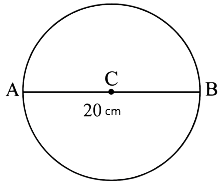
If the diameter of a circle is 20 cm, what is its radius?