📢
Geometry - Cube and Cuboid (Edges, Vertices, Faces)
Introduction
In Geometry, we study different shapes. For Standard 4, we focus on three-dimensional (3D) shapes like the Cube and Cuboid. These shapes are defined by their structural parts: Edges, Vertices, and Faces.
Explanation Step by Step
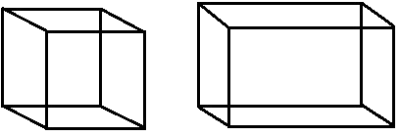
To understand 3D objects, we look at three main features:
- Face: The flat surface of the solid.
- Edge: The line segment where two faces meet.
- Vertex: The point where edges meet (the corner).
Sub-topics
Geometry - Cube and Cuboid (Edges, Vertices, Faces)
A Cube and a Cuboid share the same number of components, but a Cube's faces are all identical squares, whereas a Cuboid's faces are rectangles.
| Shape | Faces | Edges | Vertices |
|---|---|---|---|
| Cuboid | 6 | 12 | 8 |
| Cube | 6 | 12 | 8 |
Examples
Example 1
Identify the number of edges in a dice.
A dice is a cube, and it has 12 edges.
Tricks and Shortcuts
The "6-12-8" Rule: Always remember 6 Faces, 12 Edges, and 8 Vertices for both Cube and Cuboid.
Common Mistakes
Mixing up Edges and Vertices. Remember: Edges are the straight lines, Vertices are the sharp corners.
Practice Questions
Easy Questions
- How many faces does a cuboid have?
- Name an object that looks like a cube.
- How many vertices are there in a cube?
Medium Questions
- What is the shape of each face of a cube?
- How many edges meet at a single vertex in a cuboid?
- State one difference between a cube and a cuboid.
Hard Questions
- If you join two identical cubes side by side, what shape is formed?
- How many pairs of opposite faces does a cuboid have?
- Explain why a mobile phone box is usually a cuboid and not a cube.
Revision Summary
Cubes and Cuboids both have 6 faces, 12 edges, and 8 vertices. A cube is a special type of cuboid where all faces are equal squares.
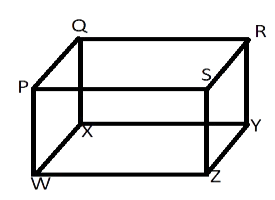
The surface area of PWXQ is 15 square cm.If PWXQ and RSZY are to be covered with silver paper, what is the area of that paper?
A
25 Chausemi
B
15 Chausemi
C
30 Chausemi
D
45 Chausemi