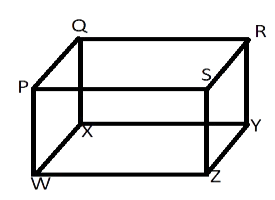
📢
Geometry - Cube and Cuboid (Edges, Vertices, Faces)
Introduction
In Geometry, we study different shapes. For Standard 4, we focus on three-dimensional (3D) shapes like the Cube and Cuboid. These shapes are defined by their structural parts: Edges, Vertices, and Faces.
Explanation Step by Step
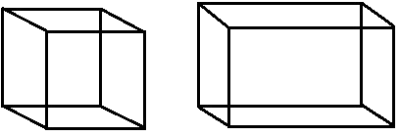
To understand 3D objects, we look at three main features:
- Face: The flat surface of the solid.
- Edge: The line segment where two faces meet.
- Vertex: The point where edges meet (the corner).
Sub-topics
Geometry - Cube and Cuboid (Edges, Vertices, Faces)
A Cube and a Cuboid share the same number of components, but a Cube's faces are all identical squares, whereas a Cuboid's faces are rectangles.
| Shape | Faces | Edges | Vertices |
|---|---|---|---|
| Cuboid | 6 | 12 | 8 |
| Cube | 6 | 12 | 8 |
Examples
Example 1
Identify the number of edges in a dice.
A dice is a cube, and it has 12 edges.
Tricks and Shortcuts
The "6-12-8" Rule: Always remember 6 Faces, 12 Edges, and 8 Vertices for both Cube and Cuboid.
Common Mistakes
Mixing up Edges and Vertices. Remember: Edges are the straight lines, Vertices are the sharp corners.
Practice Questions
Easy Questions
- How many faces does a cuboid have?
- Name an object that looks like a cube.
- How many vertices are there in a cube?
Medium Questions
- What is the shape of each face of a cube?
- How many edges meet at a single vertex in a cuboid?
- State one difference between a cube and a cuboid.
Hard Questions
- If you join two identical cubes side by side, what shape is formed?
- How many pairs of opposite faces does a cuboid have?
- Explain why a mobile phone box is usually a cuboid and not a cube.
Revision Summary
Cubes and Cuboids both have 6 faces, 12 edges, and 8 vertices. A cube is a special type of cuboid where all faces are equal squares.