Introduction
In Geometry, we study different three-dimensional shapes that occupy space. These shapes are defined by their surfaces, edges, and corners (vertices).
Explanation Step by Step
Every 3D shape has unique characteristics. An edge is where two faces meet, and a corner is where edges meet.
Sub-topics
Geometry - Cone, Cylinder, Sphere (Edges and Corners)
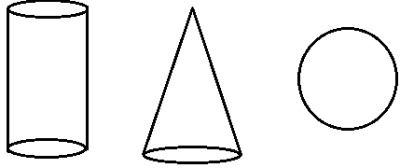
1. Cylinder: It has a curved surface and two flat circular bases. It has 2 circular edges and 0 corners.
2. Cone: It has one circular edge and one vertex (corner) at the top. It has one flat base and one curved surface.
3. Sphere: A perfectly round shape like a ball. It has 0 edges and 0 corners.
Examples
Example 1
Tricks and Shortcuts
The "Zero Rule": A sphere has 0 edges and 0 corners. A cylinder has 0 corners.
Common Mistakes
Confusing the curved boundary of a sphere as an edge. Remember, an edge requires two surfaces to meet.
Practice Questions
Easy Questions
- How many edges does a cylinder have?
- Which shape has only one corner?
- Does a sphere have any corners?
Medium Questions
- Name a shape that has 2 circular edges and no vertices.
- Compare the number of corners in a cone and a sphere. Which is greater?
- If a shape has 0 edges and 0 corners, what is its name?
Hard Questions
- How many total corners do two cones and one cylinder have together?
- Explain why a cylinder can roll and slide, focusing on its edges.
- Describe the difference between the edges of a cube and the edges of a cylinder.
Revision Summary
Cylinder: 2 edges, 0 corners. Cone: 1 edge, 1 corner. Sphere: 0 edges, 0 corners.