Introduction
Voice in English grammar describes the relationship between the action expressed by the verb and the participants identified by its arguments (subject, object, etc.). When the subject performs the action, it is in the Active Voice. When the subject receives the action, it is in the Passive Voice.
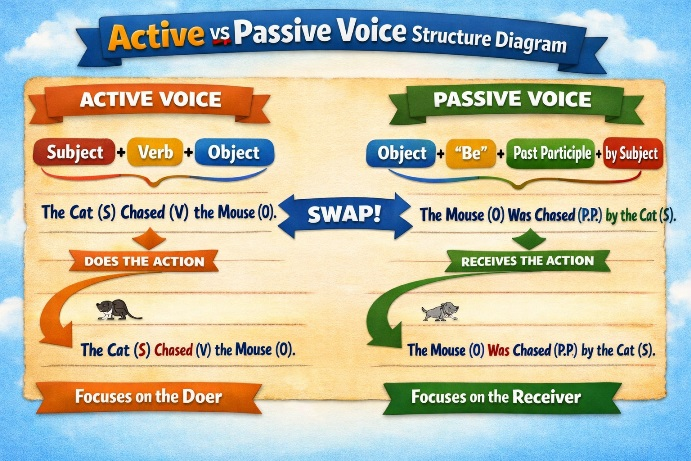
| Voice | Structure | Example Sentence |
|---|---|---|
| Active Voice | Subject + Verb + Object | The teacher explained the lesson. |
| Passive Voice | Object + Verb + Subject (by) | The lesson was explained by the teacher. |
| Active Voice | Subject acts | The dog chased the cat. |
| Passive Voice | Object receives action | The cat was chased by the dog. |
| Active Voice | Subject performs action | She wrote a letter. |
| Passive Voice | Object is emphasized | A letter was written by her. |
| Active Voice | Subject does the work | The chef cooked the meal. |
| Passive Voice | Object is highlighted | The meal was cooked by the chef. |
| Active Voice | Subject initiates | The students completed the project. |
| Passive Voice | Object is focused | The project was completed by the students. |
In Active Voice, the Subject acts. In Passive Voice, the Focus shifts to the Object receiving the action.
Explanation Step by Step
To convert Active Voice to Passive Voice, follow these simple steps: First, identify the subject, verb, and object. Move the object to the beginning of the sentence. Add a form of the verb 'to be' (am, is, are, was, were, been) based on the original tense. Use the past participle (3rd form) of the main verb. Finally, add 'by' followed by the original subject if necessary.
Sub-topics
Active Voice
Active voice is used when the person or thing doing the action is the most important part of the sentence. It makes your writing stronger, more direct, and easier to read. For example, in a real-life scenario: "The chef cooked a delicious meal." Here, the chef is the hero of the sentence.
Examples
Example 1: Daily Life
Tricky Example: No Direct Object
Passive Voice
Passive voice is used when the action itself or the receiver of the action is more important than the doer. It is often used in formal reports or when the doer is unknown. Real-life scenario: "The window was broken." We might not know who broke it, but the broken window is the main point.
Examples
Example 1: Office Scenario
Tricky Example: Commands (Imperative)
Tricks and Shortcuts
- The "By Zombies" Test: If you can add "by zombies" after the verb and it still makes grammatical sense, it is likely Passive Voice!
- V3 is Mandatory: In Passive Voice, the main verb is ALWAYS in the 3rd form (Past Participle), regardless of the tense.
Common Mistakes
- Changing the Tense: Students often change the tense (e.g., changing Present to Past). Remember: Keep the original tense, just change the form of 'to be'.
- Intransitive Verbs: Trying to make a passive sentence with verbs like "sleep," "go," or "laugh." These have no object, so they cannot be passive.
Practice Questions
Easy Questions
- Change to Passive: She eats an apple. (Real-life: Eating snacks)
- Identify the Voice: The ball was thrown by Rahul.
- Change to Passive: Tom paints the house. (Tricky: Focus on the house)
Medium Questions
- Change to Passive: My mother is baking a cake right now. (Real-life: Kitchen activity)
- Change to Active: The homework was finished by the students.
- Tricky Question: "The cat chased the mouse." Which word becomes the new subject in passive voice?
Hard Questions
- Change to Passive: Why did the teacher punish the boy? (Interrogative challenge)
- Real-life Tricky: "People say that the old mansion is haunted." Convert this using "It is said..."
- Change to Passive: Someone has stolen my wallet at the market. (Omit the unknown agent)
Revision Summary
Active Voice means the subject does the work (Subject + Verb + Object). Passive Voice means the action is done to the subject (Object + be + V3 + by Subject). Always check if the verb has an object before trying to switch voices. Use passive voice when the result is more important than the person who did it!