Introduction
In English grammar, words are categorized into different groups based on their function in a sentence. These groups are called Parts of Speech. Understanding them is like learning the building blocks of a house. Just as every brick and beam has a specific job, every word in a sentence plays a specific role to communicate meaning effectively.
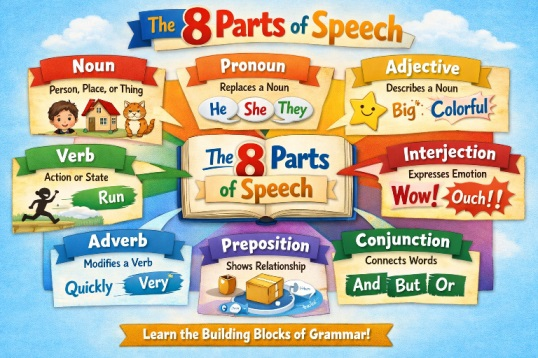
| Part of Speech | Function / Description | Example |
|---|---|---|
| Noun | Names a person, place, thing, or idea | Dog, City, Happiness |
| Pronoun | Replaces a noun | He, She, It, They |
| Adjective | Describes or modifies a noun or pronoun | Beautiful, Tall, Red |
| Verb | Shows action or state of being | Run, Is, Write |
| Adverb | Modifies a verb, adjective, or another adverb | Quickly, Very, Well |
| Preposition | Shows relationship between a noun/pronoun and another word | In, On, Under, Between |
| Conjunction | Connects words, phrases, or clauses | And, But, Or, Because |
| Interjection | Expresses sudden feeling or emotion | Wow!, Oh!, Ouch! |
| Noun | Used to identify people or objects | Teacher, Book, River |
| Pronoun | Used to avoid repetition of nouns | I, You, We |
| Adjective | Adds detail to nouns | Smart, Bright, Cold |
| Verb | Shows what someone or something does | Speak, Jump, Think |
| Adverb | Tells how, when, or where | Slowly, Yesterday, Here |
| Preposition | Links nouns to other words | At, From, With |
| Conjunction | Joins ideas or sentences | Although, While, So |
| Interjection | Used to express emotion or reaction | Hey!, Alas!, Bravo! |
Explanation Step by Step
Imagine you are telling a story about a fast car. You need a name for the object (Noun), a word to describe its speed (Adjective), and a word to say what it is doing (Verb). By combining these different categories, we create clear and logical sentences. We use 8 main categories to organize every word we speak or write.
Sub-topics
1. Noun and Pronoun
A Noun is a name of a person, place, animal, or thing. A Pronoun is a word used instead of a noun to avoid repetition.
Examples
Example 1: Noun
Example 2: Pronoun (Real-life)
2. Verb and Adverb
A Verb shows action or state of being. An Adverb describes a verb, an adjective, or another adverb.
Examples
Example 1: Action
Tricky Example (Real-life)
3. Adjective
An Adjective describes or adds more information about a Noun or Pronoun.
Examples
Example 1: Shopping scenario
4. Preposition, Conjunction, and Interjection
Prepositions show relationship (position/time). Conjunctions join words or sentences. Interjections express sudden feelings.
Examples
Example 1: Connection
Tricks and Shortcuts
- The "The" Test: If you can put "the" before a word, it is usually a Noun (e.g., the chair, the idea).
- The "Action" Check: To find a Verb, ask "Can I do this?". If you can run, jump, or think, it is a verb.
Common Mistakes
- Confusing Adjectives and Adverbs: Students often say "He runs quick" instead of "He runs quickly." Remember, adverbs usually describe the action.
- Pronoun Agreement: Using "me" instead of "I." Example: "Rahul and I went" is correct, not "Rahul and me went."
Practice Questions
Easy Questions
- Identify the Noun: "The cat sat on the mat."
- Choose the correct Pronoun: "Ravi is happy because (he / she) won the race."
- (Tricky) Identify the Verb: "The sun is hot today."
- (Real-life) Pick the Adjective: "I have a blue school bag."
Medium Questions
- Find the Adverb: "She spoke very softly to the baby."
- (Tricky) Is 'fast' a noun or adjective in: "He is a fast runner"?
- (Real-life) Identify the Preposition: "Put the money inside the wallet."
- Identify the Conjunction: "I wanted to go out, but it was raining."
Hard Questions
- (Tricky) Identify the part of speech for the underlined word: "That is a fast car, but he drives too fast."
- (Real-life) Find all 8 parts of speech in: "Wow! He and his small dog ran quickly to the park during the rain."
- Rewrite the sentence by changing the Adjective into an Adverb: "He is a brave fighter." (He fights...)
- Identify the Interjection and the Conjunction in a single sentence of your own.
Revision Summary
There are 8 parts of speech: Nouns name things, Pronouns replace them, and Verbs show action. Adjectives describe nouns, while Adverbs describe actions. Prepositions show position, Conjunctions connect thoughts, and Interjections express emotion. Mastering these helps in building perfect sentences!