Language Study - Sentence Formation
Introduction
Sentence formation is the foundational skill of communication in English. It involves arranging words in a specific, logical order to express a complete thought. A well-constructed sentence allows you to share your ideas clearly with others, whether you are writing a story or talking to a friend at the grocery store.
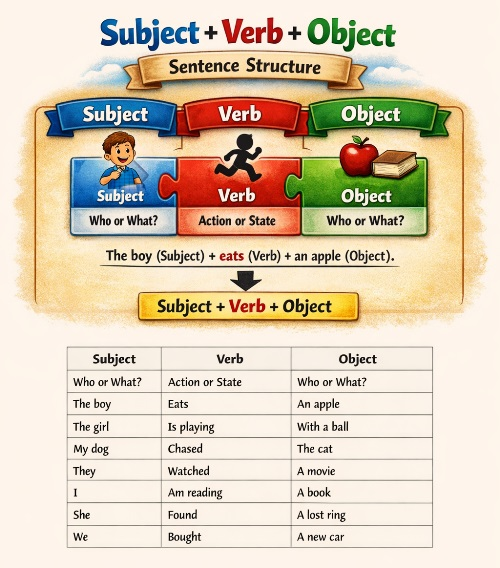
| Subject | Verb | Object |
|---|---|---|
| The boy | Eats | An apple |
| The girl | Is playing | With a ball |
| My dog | Chased | The cat |
| They | Watched | A movie |
| I | Am reading | A book |
| She | Found | A lost ring |
| We | Bought | A new car |
| The teacher | Explained | The lesson |
| Birds | Build | Nests |
| Children | Play | Games |
| The farmer | Grows | Crops |
| The sun | Gives | Light |
| The student | Answered | The question |
| The chef | Cooked | Delicious food |
| The artist | Painted | A picture |
| The baby | Drank | Milk |
| The wind | Blew | The leaves |
| The driver | Stopped | The bus |
| The singer | Sang | A song |
| The student | Wrote | An essay |
Explanation Step by Step
Every standard sentence requires a subject and a predicate. The subject is "who" or "what" the sentence is about, and the predicate contains the verb, telling us what the subject is doing or being. In English, we follow the SVO (Subject + Verb + Object) pattern. For example, in "The boy eats an apple," 'The boy' is the subject, 'eats' is the verb, and 'an apple' is the object.
Sub-topics
Language study - Sentence Formation
Building sentences correctly involves understanding word order and punctuation. In real-life situations, like ordering food at a restaurant, using the correct order helps the waiter understand your request immediately.
Examples
Example 1 (Real-Life)
Example 2 (Tricky Example)
Tricks and Shortcuts
- The "Who/What" Test: Always ask "Who is doing the action?" to find your subject instantly.
- SVO Formula: Remember the SVO (Subject-Verb-Object) sequence as the "Gold Standard" for simple sentences.
Common Mistakes
- Fragment Sentences: Writing "Because I was tired." This is incomplete. Always ensure there is a verb and a subject that makes sense alone.
- Comma Splices: Joining two complete sentences with only a comma. Use a full stop or a conjunction like 'and' instead.
Practice Questions
Easy Questions
- Rearrange the words to make a sentence: (ball / the / kicked / John).
- Real-life: You are at home. Form a sentence using the words: (thirsty / am / I).
- Tricky: Is "The dog barked." a complete sentence? (Yes/No).
Medium Questions
- Add a suitable object to complete the sentence: "The chef cooked ____."
- Real-life: You are at a railway station. Rewrite this correctly: "The train at 5 PM arrives."
- Tricky: Identify the Subject and Predicate in: "Under the bridge lived a grumpy troll."
Hard Questions
- Combine these into one logical sentence: (The weather was cold. We stayed inside. We drank cocoa.)
- Real-life Scenario: You need to explain to a doctor that your stomach hurts after eating pizza. Form a complex sentence using "because."
- Tricky: Rewrite the following sentence to change the focus from the action to the person: "The trophy was won by Sarah after a long race."
Revision Summary
Sentence formation is about placing words in the right order (Subject-Verb-Object). A complete sentence must express a full thought and contain a verb. Always check if your modifiers are placed next to the words they describe to avoid confusion. Practice by describing things you see in your daily life!