Introduction
Word formation is a powerful tool in the English language that allows us to create new words from base words. By adding specific groups of letters to the beginning or the end of a word, we can change its meaning or its grammatical category. This helps students expand their vocabulary and understand complex texts more easily.
| Prefix | Root Word | Suffix | Formed Word |
|---|---|---|---|
| Un- | Happy | Unhappy | |
| Re- | Play | Replay | |
| Dis- | Agree | Disagree | |
| Pre- | View | Preview | |
| Mis- | Understand | Misunderstand | |
| Help | -ful | Helpful | |
| Care | -less | Careless | |
| Hope | -ful | Hopeful | |
| Child | -hood | Childhood | |
| Friend | -ship | Friendship | |
| Over- | Cook | Overcook | |
| Under- | Estimate | Underestimate | |
| Act | -ion | Action | |
| Teach | -er | Teacher | |
| Use | -less | Useless |
Explanation Step by Step
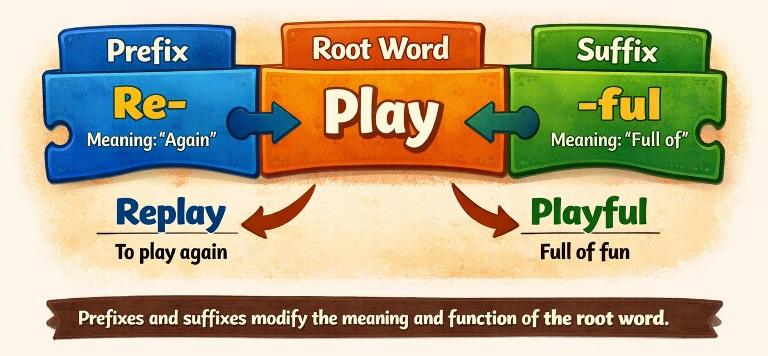
Understanding word formation involves three main parts: the root word, the prefix, and the suffix.
- Root Word: The basic word that holds the core meaning (e.g., "play").
- Prefix: Letters added to the front of a word to change meaning (e.g., "re" + "play" = "replay").
- Suffix: Letters added to the end of a word to change its form or meaning (e.g., "play" + "er" = "player").
Sub-topics
Vocabulary - Word formation (Prefix and Suffixes)
Prefixes often change the meaning to an opposite or indicate time and repetition. Suffixes often change the word from a verb to a noun, or an adjective to an adverb.
Examples
Example 1: Real-Life Scenario (Cooking)
Example 2: Tricky Example (Meaning Shift)
Tricks and Shortcuts
- The "Un-" Trick: Most adjectives can be turned into their opposites by adding "un-", "im-", or "in-". Think of them as the "No" or "Not" buttons.
- Suffix "Ly": To quickly turn a describing word (adjective) into an action-describing word (adverb), just add "-ly" (e.g., Quick to Quickly).
Common Mistakes
- Spelling Drops: Students often forget to drop the final 'e' before adding a suffix starting with a vowel (e.g., write + ing = writing, NOT writeing).
- Wrong Prefix: Using the wrong negative prefix, like saying "unpossible" instead of "impossible." Always check if the root starts with 'm' or 'p', as they often use "im-".
Practice Questions
Easy Questions
- Add a prefix to the word "happy" to make it mean the opposite.
- Add a suffix to "teach" to describe a person who does the action. (Real-life: Think of who stands at the front of your classroom!)
- Tricky Question: Which prefix would you add to "cycle" to describe a vehicle with 2 wheels?
Medium Questions
- Identify the root, prefix, and suffix in the word "Discomforting."
- Change the word "Slow" into an adverb and use it in a sentence about a turtle.
- Tricky Question: Does the word "Understand" contain a prefix "Under-"? Explain if "stand" is the root word here in terms of meaning.
Hard Questions
- Create 3 different words using the root "Act" by adding various prefixes and suffixes. (Real-life: Think about movies and behavior).
- If a businessman is "unsuccessful," what two changes happened to the root word "success"?
- Tricky Question: In a real-life legal case, a document might be "irreplaceable." Break this word down and explain why it is harder to recover than a "replaceable" one.
Revision Summary
Word formation uses prefixes (at the start) and suffixes (at the end) to modify root words. Prefixes like "un-" or "re-" change the meaning. Suffixes like "-ness" or "-ly" change the word type. Always watch your spelling when adding suffixes!