Introduction
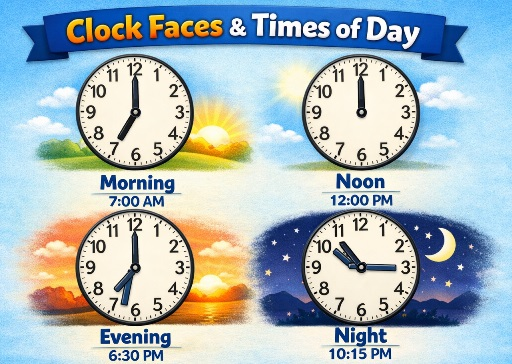
Understanding time is a vital skill for daily life. Clocks help us organize our day, from waking up for school to catching a bus. This guide explores the relationship between hours and minutes, the difference between 12-hour and 24-hour formats, and how to read the positions of the clock hands accurately by identifying visual representations.
Explanation Step by Step
Reading a clock involves looking at two main hands: the short hour hand and the long minute hand. For the 24-hour format, used often in travel, we add 12 to any time from 1:00 PM onwards. We can also use visual symbols (Unicode) to represent these times. For example, the symbol 🕙 represents 6 o'clock.
Sub-topics
Miscellaneous - Clocks
Clocks are divided into 12 sections for hours and 60 small marks for minutes. Identifying the time based on the visual "face" of the clock is essential for quick reading.
Examples
Example 1: The Bus Schedule
Example 2: Tricky Example (Visual Representation)
Tricks and Shortcuts
- The "Add 12" Rule: To quickly convert PM time to 24-hour time, just add 12 to the hour (e.g., 5 PM + 12 = 17:00).
- Symbol Recognition: When looking at clock symbols, identify the "straight up" hand first; if the other hand is at 12, it is an exact hour.
Common Mistakes
- Mirror Confusion: In some symbols, students confuse 9 o'clock (🕘 style) with 3 o'clock. Always check the direction of the short hand.
- Confusing "To" and "Past": "10 to 5" is 4:50, not 5:10. Always look at the next hour for "to" questions.
Practice Questions
Easy Questions
- Identify the time shown by this symbol: 🕚.
- If a clock shows 🕒 (3 o'clock), where is the minute hand pointing?
- Tricky Real-Life Question: A movie starts at the time shown by 🕑 (2 o'clock) and lasts 1 hour. What time does it end?
Medium Questions
- A train arrives at the time represented by 🕗 (4 o'clock) in the afternoon. Express this in 24-hour format.
- Which clock symbol represents "Quarter past 12" if we only look at the hour hand's primary position: 🕐 or 🕕?
- Tricky Real-Life Question: You have a meeting at 🕙 (6 o'clock). If you are 15 minutes late, what is the exact time?
Hard Questions
- Look at the symbol 🕜 (9 o'clock). If you rotate this clock 180 degrees, what new time would the hands appear to show?
- A clock symbol shows 🕖 (7 o'clock). If the clock is actually 20 minutes fast, what is the real time?
- Tricky Real-Life Question: If a digital clock shows 00:00, which Unicode clock symbol best represents this start of the day: 🕐 or 🕛?
Revision Summary
Clocks use 12-hour and 24-hour formats. Symbols like 🕘 help us visualize the hand positions. Remember that "past" means minutes after and "to" means minutes before. Always add 12 for PM times in the 24-hour system. ⌚