Introduction
Grammar is the backbone of any language. It provides the rules and structure that allow us to communicate clearly. For students in 7th and 8th grade, mastering grammar helps in building strong writing and speaking skills. This guide focuses on understanding how sentences are constructed and how to change the way we report what others say using Direct and Indirect Speech.
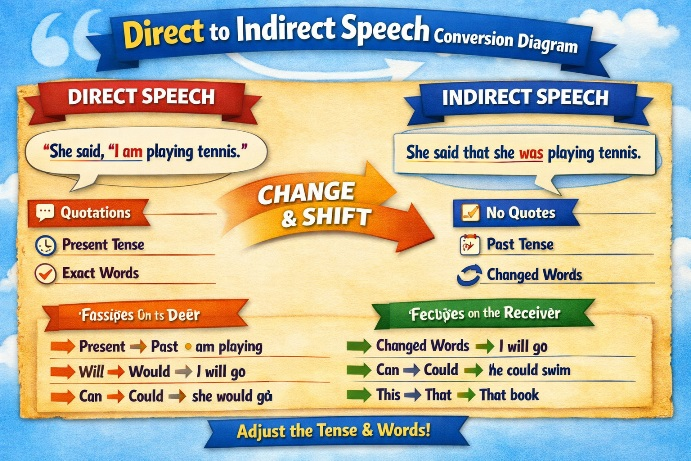
| Form | Structure | Example |
|---|---|---|
| Direct Speech | Speaker’s exact words inside quotation marks | She said, "I am happy." |
| Indirect Speech | Reporter conveys the meaning without quotation marks | She said that she was happy. |
| Direct Speech | Exact words spoken | He asked, "Where are you going?" |
| Indirect Speech | Question converted into statement form | He asked where I was going. |
| Direct Speech | Command in quotes | The teacher said, "Open your books." |
| Indirect Speech | Command reported with “to” | The teacher told us to open our books. |
| Direct Speech | Exclamation in quotes | She exclaimed, "What a beautiful view!" |
| Indirect Speech | Exclamation reported with “that” | She exclaimed that it was a beautiful view. |
Explanation Step by Step
When we talk about what someone else said, we use two methods. Direct Speech uses the exact words of the speaker inside quotation marks. Indirect (Reported) Speech conveys the same meaning but changes the structure, tenses, and pronouns to reflect that the conversation happened in the past or from a different perspective.
Sub-topics
Direct Speech
Direct speech repeats the exact words spoken. We use a comma after the reporting verb and place the spoken words inside double quotation marks (" "). For example, when you tell your mom exactly what your teacher said in class.
Examples
Example 1: Basic Direct Speech
Tricky Example: Direct Speech with Interruption
Indirect Speech
Indirect speech reports the message without using the exact words. We remove quotation marks, use the connector 'that', and change the tense (usually one step back). This is like telling a friend about a conversation you had yesterday at the park.
Examples
Example 1: Present to Past
Tricky Example: Universal Truths
Indirect: The teacher said that the sun rises in the east.
Tricks and Shortcuts
- The Time Machine Rule: In Indirect Speech, "now" becomes "then," "today" becomes "that day," and "tomorrow" becomes "the next day."
- Pronoun Swap: Change pronouns based on who is speaking (I becomes He/She, We becomes They).
Common Mistakes
- Forgetting 'that': Students often forget to use the conjunction 'that' when removing quotation marks. Always remember to bridge the sentence!
- Tense Over-correction: Do not change the tense if the reporting verb is in the present (e.g., He says, "I am happy" becomes He says that he is happy).
Practice Questions
Easy Questions
- Change to Indirect: Sita said, "I like mangoes."
- Change to Direct: He said that he was busy. (Real-life: Imagine reporting a busy shopkeeper).
- Tricky Question: Identify if this is Direct or Indirect: They told us they would arrive late.
Medium Questions
- Change to Indirect: The boy said, "I have finished my homework."
- Real-life Scenario: Your friend says, "I cannot find my keys." Report this to your mother.
- Tricky Question: Change to Indirect: Rahul says, "I am a brave boy." (Watch the reporting verb!)
Hard Questions
- Change to Indirect: "Where are you going?" asked the stranger.
- Real-life Scenario: A shopkeeper tells a customer, "If you buy two shirts, I will give you a 10% discount." Report this deal to your father.
- Tricky Question: Change to Indirect: My father said, "Honesty is the best policy."
Revision Summary
Grammar helps us speak correctly. Direct speech uses "quotes" for exact words. Indirect speech removes quotes and changes the tense. Always remember to check the reporting verb and universal truths before changing the tense!