Introduction
Vocabulary is the foundation of any language. It refers to the set of words that a person knows and uses. To make learning fun, we use word puzzles like crosswords and riddles. These activities improve memory, critical thinking, and spelling while expanding your word power.
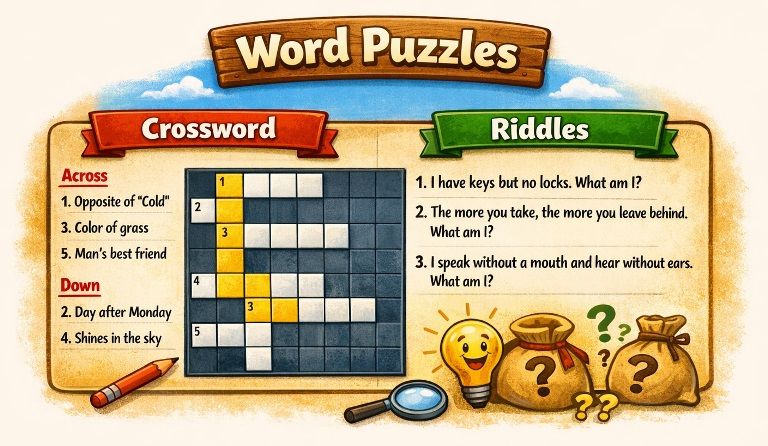
| Type | Clue / Riddle | Answer |
|---|---|---|
| Crossword | Opposite of cold (3 letters) | Hot |
| Crossword | A fruit that keeps the doctor away (5 letters) | Apple |
| Crossword | Day after Monday (7 letters) | Tuesday |
| Crossword | Shines in the sky (3 letters) | Sun |
| Crossword | Man’s best friend (3 letters) | Dog |
| Riddle | I have keys but no locks. I can be played but not opened. What am I? | Piano |
| Riddle | The more you take, the more you leave behind. What am I? | Footsteps |
| Riddle | I’m tall when I’m young, and short when I’m old. What am I? | Candle |
| Riddle | I speak without a mouth and hear without ears. What am I? | Echo |
| Riddle | I’m always running but never move. What am I? | Time |
| Crossword | Opposite of up (4 letters) | Down |
| Crossword | Color of grass (5 letters) | Green |
| Crossword | Opposite of night (3 letters) | Day |
| Crossword | Bird that cannot fly (7 letters) | Penguin |
| Crossword | Largest animal on land (8 letters) | Elephant |
Word puzzles like crosswords and riddles make learning new vocabulary engaging and interactive.
Explanation Step by Step
Understanding vocabulary through puzzles involves two main skills: context and logic. In crosswords, you use "Across" and "Down" clues to fit words into a grid. In riddles, you use descriptive clues to guess a specific object or concept. Both require you to think about word meanings, synonyms, and spelling.
Sub-topics
Word puzzles - Crossword puzzles, Riddles
Crosswords help in recognizing letter patterns, while riddles focus on figurative language and deep meanings. For example, a riddle describes something without naming it, forcing your brain to search for the right vocabulary word.
Examples
Example 1: Simple Riddle
Example 2: Real-Life Scenario
Tricky Example: Contextual Crossword Clue
Tricks and Shortcuts
- Count the Boxes: In crosswords, always count the number of squares first to narrow down your word choices.
- Focus on Intersections: Fill in the words you are 100% sure about first. The overlapping letters will help you solve the harder clues.
Common Mistakes
- Spelling Errors: Writing "Calendar" as "Calender" will break the entire crossword grid. Always double-check vowels.
- Ignoring Tense: If a clue is in the past tense (e.g., "Jumped"), the answer must also be in the past tense.
Practice Questions
Easy Questions
- Riddle: What has to be broken before you can use it? (Real-life object)
- Crossword Clue: The opposite of "Difficult" (4 letters).
- Tricky Question: I am tall when I am young, and I am short when I am old. What am I?
Medium Questions
- Riddle: What has hands but cannot clap? (Real-life object)
- Crossword Clue: A person who treats sick people (6 letters).
- Tricky Question: What word is spelled incorrectly in every single dictionary?
Hard Questions
- Riddle: What can travel around the world while staying in a corner? (Real-life scenario: Sending mail)
- Crossword Clue: A synonym for "Abundant" starting with 'P' (8 letters).
- Tricky Question: I have cities, but no houses. I have mountains, but no trees. I have water, but no fish. What am I?
Revision Summary
Vocabulary is essential for communication. Using puzzles like crosswords and riddles helps you learn new words in a fun way. Remember to check your spelling, pay attention to word length in grids, and use logic to solve riddles. Practice every day to build a strong word bank!