Introduction
Applied Mathematics focuses on the practical application of mathematical principles in daily life. One of the most vital aspects is "Interest" which is the cost of borrowing money or the reward for saving it. Understanding Simple and Compound Interest helps in making smart financial decisions.
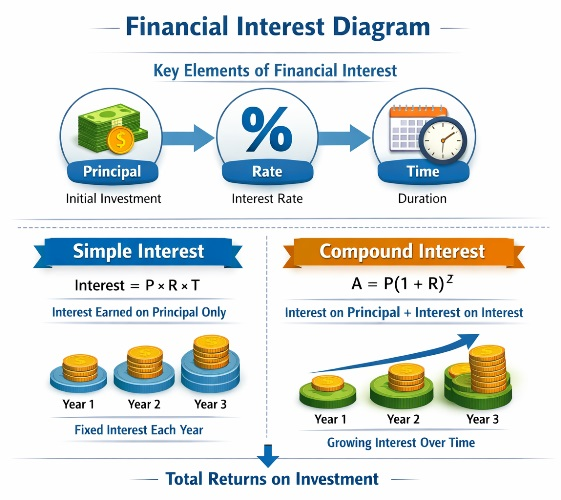
Key elements of financial interest: Principal, Rate, and Time.
Explanation Step by Step
Step 1: Identify the Principal (P), Rate (R), and Time (T).
Step 2: For Simple Interest (SI), use the formula SI = (P * R * T) / 100.
Step 3: For Compound Interest (CI), calculate the amount for each year by adding interest to the previous year's principal.
Sub-topics
Applied mathematics - Simple interest, Compound interest
Simple interest remains constant over the period. Compound interest grows exponentially because the interest earned also earns interest in the subsequent periods.
Examples
Example 1: Savings Account (Real-life)
Deposit 5,000 at 8% SI for 2 years.
Tricky Example: Quarterly Compounding
If 1,000 is invested at 10% interest compounded half-yearly for 1 year, what happens to the rate?
Tricks and Shortcuts
1. Difference between CI and SI for 2 years = P * (R/100)^2.
2. To double your money with SI, Time = 100 / Rate.
Common Mistakes
1. Using the wrong 'Time' unit. Always convert months/days into years (e.g., 73 days = 1/5 year).
2. Confusing 'Amount' (Total) with 'Interest' (Extra part).
Practice Questions
Easy Questions
- Calculate SI on 3,000 at 10% for 2 years.
- If you borrow 500 and pay back 550 after a year, what is the interest amount? (Real-life)
- Tricky: Does the Principal ever decrease in Simple Interest calculations?
Medium Questions
- Find the CI on 4,000 at 5% for 2 years.
- A shopkeeper offers a loan at 15% SI. If you pay 2,250 interest in 3 years, how much did you borrow? (Real-life)
- Tricky: If the rate of interest is 10% per annum, what is the interest for 0 years?
Hard Questions
- A sum becomes double in 10 years at SI. Find the rate of interest.
- A person invests 10,000 in a business. It grows by 10% in the first year and 20% in the second year (compounded). Find final value. (Real-life)
- Tricky: The difference between CI and SI on a sum for 2 years at 10% is 50. Find the sum.
Revision Summary
Simple interest is calculated only on the original sum. Compound interest is calculated on the original sum plus all accumulated interest. Remember: P is for Principal, R is for Rate, and T is for Time.