Introduction
Pythagoras Theorem is a fundamental rule in Geometry used for right-angled triangles. It helps us find the length of a missing side when two sides are known. This concept is widely used in construction, navigation, and even in calculating the shortest path while walking across a park.
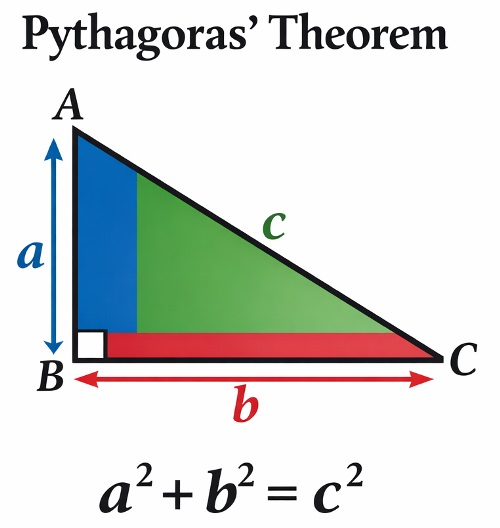
In a right-angled triangle, the square of the hypotenuse is equal to the sum of the squares of the other two sides.
Explanation Step by Step
A right-angled triangle has one angle of 90 degrees. The side opposite to this angle is called the Hypotenuse, which is the longest side. The other two sides are the height and the base.
Sub-topics
Geometry - Pythagoras Theorem
The theorem states that for any right triangle with legs 1 and 2, and hypotenuse 3, the relationship is 12 + 22 = 32.
Examples
Example 1: Real-Life Ladder
A 5-meter ladder is placed against a wall. The base of the ladder is 3 meters away from the wall. How high does the ladder reach?
Tricky Example: The Diagonal Path
Rahul walks 80 meters North and then 60 meters East. If he wants to return to the starting point by the shortest diagonal route, how much distance must he cover?
Tricks and Shortcuts
- Pythagorean Triplets: Memorize common sets like (3, 4, 5), (5, 12, 13), and (8, 15, 17) to solve questions instantly.
- Scale Factor: If (3, 4, 5) is a triplet, then (6, 8, 10) is also a triplet (multiplied by 2).
Common Mistakes
- Wrong Side: Students often mistake the longest side for a base or height. Always identify the side opposite to 90 degrees as the hypotenuse.
- Adding before Squaring: Do not add the side lengths first. Always square the numbers individually before adding them.
Practice Questions
Easy Questions
- A right triangle has sides 6 cm and 8 cm. Find the hypotenuse.
- If the hypotenuse is 13 cm and one side is 5 cm, find the third side.
- Real-Life: A rectangular TV screen has a width of 4 inches and height of 3 inches. What is the diagonal size?
Medium Questions
- Find the diagonal of a square whose side length is 10 cm.
- Tricky: In a triangle, sides are 7, 24, and 25. Is this a right-angled triangle? Prove using the theorem.
- Real-Life: An ant crawls 12 cm up a wall and 9 cm across the floor. How far is it from its starting point?
Hard Questions
- The perimeter of a right-angled triangle is 30 cm and the hypotenuse is 13 cm. Find the other two sides.
- Tricky Real-Life: Two poles of height 11 meters and 6 meters stand on a plane ground. If the distance between their feet is 12 meters, find the distance between their tops.
- A wire is stretched from the top of an 8-meter pole to a point 6 meters from its base. If the wire costs 50 rupees per meter, find the total cost.
Revision Summary
Pythagoras Theorem only applies to right-angled triangles. The formula is a2 + b2 = c2, where c is the hypotenuse. Always identify the hypotenuse first as it is the longest side. Using triplets can save time during exams.