Introduction
Ratio and Proportion are tools used to compare quantities, while Variation explains how one quantity changes when another does. In "Time, Work, and Speed," these concepts are vital. If you double your speed, you reach your destination in half the time—this is a classic example of inverse variation that we use every day.
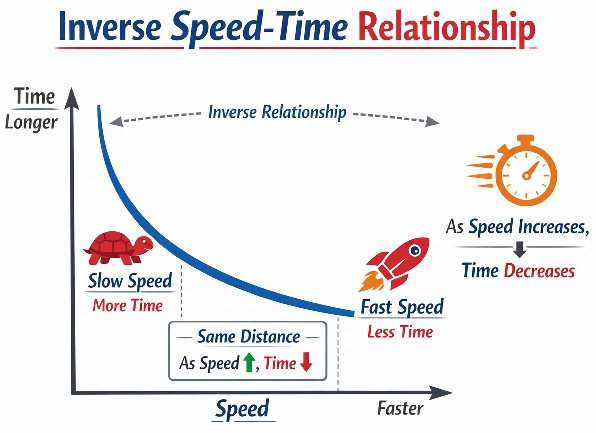
Understanding the Inverse Relationship: As Speed increases, Time decreases for the same distance.
Explanation Step by Step
To solve these problems, first identify if the relationship is Direct (both increase) or Inverse (one increases, other decreases). For Time and Work, the relationship is almost always Inverse. Use the "Product Constant" method where the total work (Men × Days) remains the same.
Sub-topics
Operations on numbers - Ratio, proportion and variation
This subtopic covers how to calculate speed, determine the number of days required for workers to complete a task, and how to distribute quantities based on given ratios.
Examples
Example 1: Time and Speed
Tricky Example: The Shared Work Puzzle
Tricks and Shortcuts
- The "MDH" Formula: For work problems, use $M_1 \times D_1 \times H_1 = M_2 \times D_2 \times H_2$ (Men, Days, Hours). It solves almost any work comparison instantly.
- The Ratio Flip: If the speed ratio of two cars is 3:4, the ratio of time taken to cover the same distance is 4:3. Just flip the numbers!
Common Mistakes
- Using Cross-Multiplication for everything: Cross-multiplication works for Direct Proportion, but fails for Inverse Proportion (Time and Work).
- Ignoring Units: Calculating speed using kilometers but time in minutes without converting.
Practice Questions
Easy Questions
- Divide 100 apples between A and B in the ratio 2:3.
- If a bike travels at 40 km/hr, how far will it go in 2.5 hours?
- Tricky Question: If a map scale is 1:500, does a larger ratio mean a larger or smaller actual area?
Medium Questions
- 10 workers can build a wall in 8 days. How many workers are needed to finish in 4 days?
- A car travels at 50 km/hr and arrives in 3 hours. How fast must it go to arrive in 2 hours?
- Tricky Real-Life: A recipe for 4 people uses 200g of flour. How much flour is needed for 7 people?
Hard Questions
- A can do a work in 10 days and B in 15 days. How many days if they work together?
- If 12 pumps can empty a tank in 20 minutes, how many extra pumps are needed to empty it in 15 minutes?
- Tricky Real-Life: A car increases its speed by 25%. What is the percentage reduction in time taken for the same journey?
Summary
Always identify the type of variation first. Use the MDH formula for work and the Ratio Flip for speed. Always keep your units consistent to avoid calculation errors.