Introduction
In mathematics, understanding the relationship between numbers during division is fundamental. This topic covers Dividend, Divisor, and the rules of Divisibility that allow us to determine if a number is divisible by another without performing long division.
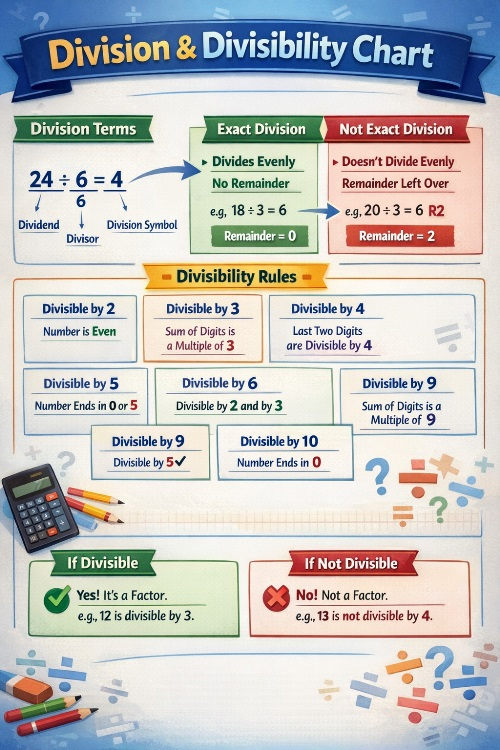
Visual representation of Divisibility Rules and Number Operations
Explanation Step by Step
When we divide a number (Dividend) by another number (Divisor), and the remainder is zero, we say the dividend is perfectly divisible by the divisor. Tests of divisibility are quick rules to check this.
Sub-topics
Operations on numbers - Dividend, Divisor, Test of Divisibility
A dividend is the number being divided. A divisor is the number by which the dividend is divided. Divisibility tests help find factors quickly. For example, a number is divisible by 5 if it ends in 0 or 5.
| Divisor | Condition | Example |
|---|---|---|
| 2 | The last digit is even (0, 2, 4, 6, 8). | 1,256 |
| 3 | The sum of the digits is divisible by 3. | 321 (3+2+1=6) |
| 4 | The last two digits are divisible by 4. | 5,612 (12 ÷ 4 = 3) |
| 5 | The last digit is 0 or 5. | 95, 1,000 |
| 6 | The number is divisible by both 2 and 3. | 42 |
| 8 | The last three digits are divisible by 8. | 2,160 (160 ÷ 8 = 20) |
| 9 | The sum of the digits is divisible by 9. | 819 (8+1+9=18) |
| 10 | The number ends in 0. | 4,560 |
| 11 | Difference between the sum of odd and even position digits is 0 or 11. | 121 (1+1=2, 2; 2-2=0) |
Examples
Example 1: Test of 4
Tricky Example
Tricks and Shortcuts
* Divisibility by 6: If a number is divisible by both 2 and 3, it is divisible by 6.
* Divisibility by 5: Just look at the last digit; if it is 0 or 5, the whole number works.
Shortcut: For large numbers, always check the "0" and "5" tests first as they are the fastest to identify!
Common Mistakes
* Mistake: Thinking all odd numbers are divisible by 3. Correction: 7 is odd but not divisible by 3; always use the sum of digits rule.
* Mistake: Confusing Dividend and Divisor. Correction: Remember, Divisor is the 'doer' (the one that divides).
Practice Questions
Easy Questions
- Identify the Divisor in the operation 40 ÷ 8 = 5.
- Is 150 divisible by 10?
- (Tricky) Every number is a divisor of ____? (Fill in the blank: itself).
Medium Questions
- Check if 789 is divisible by 3 using the sum of digits.
- Find the smallest number that must be added to 23 to make it divisible by 5.
- (Tricky) If a number is divisible by 10, must it also be divisible by 2 and 5? Why?
Hard Questions
- A number 56X2 is divisible by 4. What are the possible values for X?
- Check the divisibility of 12345 by 3, 5, and 9.
- (Tricky) Can a number be divisible by 4 but not by 2? Explain your answer.
Revision Summary
Divisibility rules make calculations faster. Remember the key rules: 2 (even last digit), 3 (sum of digits), 5 (ends in 0 or 5), and 10 (ends in 0). A divisor that leaves no remainder is a factor of the dividend.