Introduction
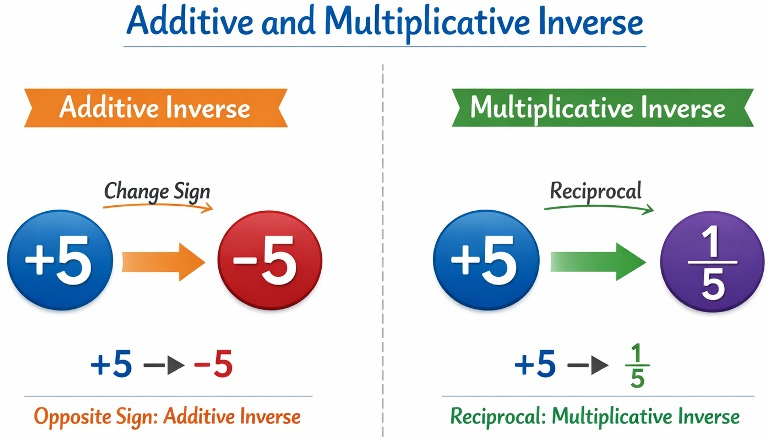
In mathematics, every number has specific partners called inverses. These inverses help us reach target values like 0 or 1. Understanding additive and multiplicative inverses is essential for solving algebraic equations and simplifying complex fractions.
Explanation Step by Step
The additive inverse of a number is what you add to it to get a sum of 0. Think of it as the opposite on a number line. The multiplicative inverse (or reciprocal) is what you multiply a number by to get a product of 1.
Sub-topics
Number Work - Additive inverse and multiplicative inverse of the number
The additive inverse of a is -a. The multiplicative inverse of a is 1/a.
Examples
Example 1: Finding Inverses of 5
Example 2: The Zero Paradox
Example 3: Solving with Additive Inverse
Example 4: Solving with Multiplicative Inverse
Tricks and Shortcuts
To find the additive inverse, just "flip the sign." To find the multiplicative inverse, "flip the fraction."
Always convert mixed fractions (like 2 1/2) to improper fractions (5/2) before looking for a multiplicative inverse.
Common Mistakes
Students often forget that the multiplicative inverse of a negative number is still negative. For example, the multiplicative inverse of -3 is -1/3, not 1/3.
Thinking that -1 doesn't have a multiplicative inverse. It does! -1 multiplied by -1 equals 1.
When solving ( -4 )x = 20, students often add 4 to both sides. Remember, -4 is multiplying x, so you must use the multiplicative inverse (-1/4), not the additive inverse (+4).
Practice Questions
Easy Questions
- What is the additive inverse of -(-5)?
- Find the multiplicative inverse of 7.
- What is the sum of a number and its additive inverse?
Medium Questions
- Find the multiplicative inverse of -4/5.
- What is the additive inverse of -12?
- Multiply 6 by its multiplicative inverse. What is the result?
- Solve: 2x + 6 = 16 (Use additive inverse first, then multiplicative).
Hard Questions
- Find the sum of the additive inverse of 8 and the multiplicative inverse of 1/2.
- If a number is x, write an expression for the product of its additive inverse and its multiplicative inverse.
- Find the multiplicative inverse of the additive inverse of -2/3.
- If x is a negative integer, is its multiplicative inverse positive or negative? Explain.
Revision Summary
The additive inverse results in 0 when added. The multiplicative inverse results in 1 when multiplied. Zero has an additive inverse (0) but no multiplicative inverse.
Additive inverse: a → -a. Multiplicative inverse: a → 1/a. Zero is the ultimate "trap" number—it has no reciprocal.
Equations are solved by performing the inverse operation. Additive inverses handle addition/subtraction, and multiplicative inverses handle multiplication/division.