Introduction
Dialogue writing is the art of capturing a conversation between two or more people. In educational exercises, it tests your ability to understand context, emotional tone, and logical flow between speakers. By choosing the right words to complete a conversation, you demonstrate a grasp of social interactions and linguistic nuances.
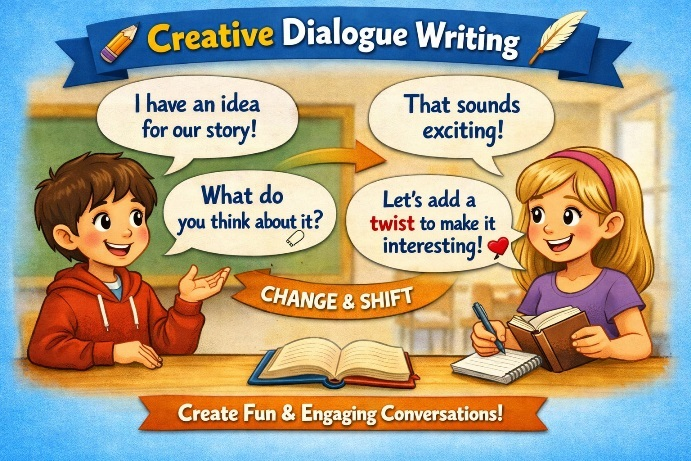
Effective dialogue flows logically from one person's statement to the next person's response.
Explanation Step by Step
To master dialogue completion, follow these simple steps: 1. Read the entire conversation first to understand the setting. 2. Identify the relationship between the speakers (friends, teacher-student, stranger). 3. Look for clues in the previous sentence—is it a question, a surprise, or a request? 4. Select the option that matches the mood (happy, sad, polite, or secretive).
Sub-topics
Creative Writing - Dialogue Completion
This sub-topic focuses on filling gaps in a conversation based on the subject being discussed. Whether it's a real-life scenario like shopping or a secret shared between friends, the flow must remain natural.
Examples
Example 1: The Surprise
A: Guess what is in my bag?
B: A chocolate!
A: How did you know?
B: It's a __________!
Tricky Example (Real-Life Scenario: Market)
Shopkeeper: That will be 50 rupees.
Customer: But the sign says 40!
Shopkeeper: Oh, the sign is __________.
Tricks and Shortcuts
- The Punctuation Hint: Look at the end of the blank. If there is an exclamation mark (!), the answer is likely an emotional word like "Wonderful" or "Unbelievable".
- Tone Matching: If the speaker uses "Please", ensure the response is equally polite.
Common Mistakes
- Ignoring the "Why": Students often pick a word that makes sense alone but doesn't fit the "How did you know?" logic of the dialogue.
- Mixing Tenses: Choosing a past tense response for a present tense question is a frequent error.
Practice Questions
Easy Questions
Teacher: Why are you late?
Student: I __________ the bus.
(1. Found 2. Missed 3. Saw 4. Ran)
Mother: Eat your vegetables.
Child: But I don't __________ them!
(1. Like 2. Know 3. Want 4. Help)(Tricky)
Friend A: Can I borrow your pen?
Friend B: __________, I only have one.
(1. Yes 2. Sure 3. Sorry 4. Take)
Medium Questions
Doctor: How do you feel?
Patient: Not very well, my head __________.
(1. Thinks 2. Jumps 3. Hurts 4. Rings)
(Real-Life)
Cashier: Do you have a discount coupon?
Customer: No, I __________ it at home. (
1. Lost 2. Forgot 3. Threw 4. Sold)
(Tricky)
Ram: Is it going to rain?
Sam: Look at those __________ clouds!
(1. White 2. Small 3. Dark 4. High)
Hard Questions
(Real-Life)
Travel Agent: Your flight is confirmed.
Passenger: Great! Do I need to __________ my seat?
(1. Make 2. Buy 3. Reserve 4. Seat)
(Tricky)
Police: Did you see the thief?
Witness: No, it happened in the __________ of an eye!
(1. Flash 2. Blink 3. Wink 4. Speed)
Interviewee: Thank you for the opportunity.
Employer: We will __________ you soon.
(1. Tell 2. Call 3. Contact 4. Speak)
Revision Summary
Dialogue writing requires careful reading of the context. Always check if the response follows the logic of the previous statement. Look for keywords like "guess", "believe", or "sorry" to understand the emotion. Keep the conversation natural and check your tenses!