Introduction
In English grammar, Degrees of Comparison are used to describe, compare, and rank the qualities of nouns. Instead of just saying a building is "big," we use these degrees to explain how it relates to other buildings. This is essential for precise communication in everything from science reports to daily shopping.
| Positive Degree | Comparative Degree | Superlative Degree | Example Sentence |
|---|---|---|---|
| Tall | Taller | Tallest | He is the tallest boy in the class. |
| Big | Bigger | Biggest | This is the biggest building in town. |
| Small | Smaller | Smallest | That is the smallest box. |
| Fast | Faster | Fastest | She runs the fastest in the race. |
| Strong | Stronger | Strongest | He is the strongest player. |
| Happy | Happier | Happiest | She is the happiest person I know. |
| Beautiful | More beautiful | Most beautiful | This is the most beautiful garden. |
| Interesting | More interesting | Most interesting | That was the most interesting story. |
| Expensive | More expensive | Most expensive | This is the most expensive car. |
| Useful | More useful | Most useful | This tool is the most useful. |
| Good | Better | Best | He is the best singer. |
| Bad | Worse | Worst | This is the worst mistake. |
| Old | Older | Oldest | He is the oldest member of the group. |
| Young | Younger | Youngest | She is the youngest child. |
| Rich | Richer | Richest | He is the richest man in the city. |
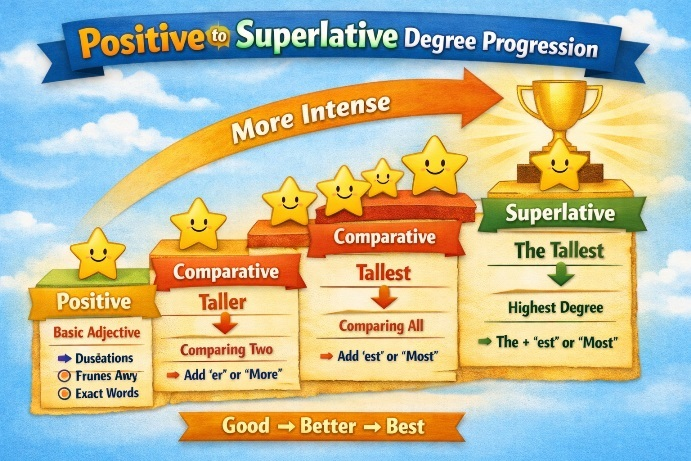
A visual comparison showing the progression from Positive to Superlative degrees.
Sub-topics
1. Positive Degree
The Positive degree is the simplest form of an adjective. It describes a quality without making any comparison to others. In real life, we use this to state a simple fact about an object or person.
Examples
Example 1 (Real-Life: Weather)
Tricky Example (Equality)
2. Comparative Degree
The Comparative degree is used to compare exactly two people, animals, or things. It indicates that one has a higher or lower degree of a quality than the other. We usually add "-er" to the adjective or use the word "more."
Examples
Example 1 (Real-Life: Shopping)
Tricky Example (Irregular Change)
3. Superlative Degree
The Superlative degree compares more than two things and identifies the one that has the highest or lowest degree of a quality. It represents the extreme. We usually add "-est" or use "most."
Examples
Example 1 (Real-Life: School)
Tricky Example (The Article 'The')
Tricks and Shortcuts
- The 'Than' Rule: If you see the word "than" in a sentence, it is almost always a Comparative degree.
- The 'The' Rule: If you see the word "the" immediately before an adjective, it is usually a Superlative degree.
Common Mistakes
- Double Comparison: Saying "more braver" or "most smartest." Use only one (either the suffix or the word "more/most").
- Incorrect Comparison: Comparing a person to a thing. Correct: "My car is faster than yours" (not "than you").
Practice Questions
Easy Questions
- Identify the degree: "The apple is sweet."
- Real-Life: Fill in the blank: An airplane is ______ (fast) than a car.
- Tricky: What is the comparative form of "Happy"? (Watch the spelling!)
Medium Questions
- Change to Comparative: "No other student is as kind as Sara."
- Real-Life: Compare three fruits (Apple, Banana, Watermelon) using the adjective "Heavy" in a superlative sentence.
- Tricky: Rewrite the sentence "Iron is more useful than gold" into Positive degree without changing the meaning.
Hard Questions
- Identify and fix the error: "This is the most baddest movie I have ever seen."
- Real-Life Tricky: You have 2 pens of equal price. Write a sentence in Positive degree using "expensive."
- Tricky: Change "Lead is the heaviest of all metals" into both Positive and Comparative degrees.
Revision Summary
Positive degree describes one thing (Cold). Comparative compares two things using 'than' (Colder). Superlative compares three or more using 'the' (Coldest). Remember that long words like 'Beautiful' need 'more' or 'most' instead of suffixes.