Introduction
In English grammar, a sentence is a group of words that expresses a complete thought. Depending on the purpose of communication—whether we are sharing information, asking a question, giving an order, or expressing a strong emotion—we use different types of sentences. Understanding these types helps in better writing and clear communication.
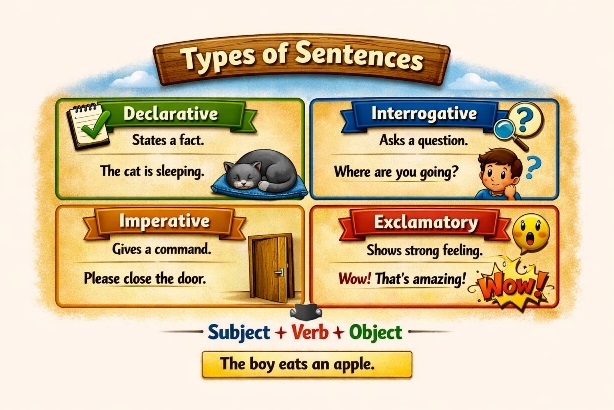
| Type of Sentence | Purpose / Function | Example |
|---|---|---|
| Declarative | States a fact or opinion | The cat is sleeping. |
| Interrogative | Asks a question | Where are you going? |
| Imperative | Gives a command or request | Please close the door. |
| Exclamatory | Expresses strong emotion | Wow! That’s amazing! |
| Declarative | Gives information | She loves reading books. |
| Interrogative | Seeks an answer | Did you finish your homework? |
| Imperative | Gives instruction | Turn off the lights. |
| Exclamatory | Shows surprise or excitement | What a beautiful day! |
| Declarative | States a truth | Water boils at 100°C. |
| Interrogative | Requests information | Can you help me? |
| Imperative | Gives direction | Follow the rules. |
| Exclamatory | Expresses joy | Hurray! We won the match! |
| Declarative | Shares an idea | I enjoy painting. |
| Interrogative | Asks for clarification | Who is your teacher? |
| Imperative | Gives advice | Be kind to others. |
| Exclamatory | Shows fear or shock | Oh no! The glass broke! |
A visual guide showing how sentences change based on whether they state facts, ask questions, give commands, or express strong feelings.
Explanation Step by Step
Sentences are categorized into four main types based on their function. We look at the word order and the punctuation mark at the end to identify them. For example, a statement ends with a full stop, while a question ends with a question mark.
Sub-topics
Classification of Sentences
There are four primary types: Assertive (statements), Interrogative (questions), Imperative (commands/requests), and Exclamatory (emotions).
Examples
Example 1: Assertive Sentence
Example 2: Real-Life Situation (Shopping)
Tricky Example: Rhetorical Question
Tricks and Shortcuts
- Look at the end: "?" means Interrogative, "!" means Exclamatory.
- If the sentence starts with a Verb (like "Sit", "Close", "Don't"), it is usually Imperative.
Common Mistakes
- Forgetting the question mark at the end of Interrogative sentences.
- Confusing a request (Imperative) with a statement (Assertive) just because both end in a full stop. Check if the sentence gives an order!
Practice Questions
Easy Questions
- Identify the type: "The birds are flying in the sky."
- Identify the type: "Where do you live?"
- Real-Life: Your mother says, "Clean your room." What type of sentence is this? (Tricky: Is it a statement or a command?)
Medium Questions
- Identify the type: "What a beautiful flower this is!"
- Change the following Assertive sentence into Interrogative: "He is a good boy."
- Real-Life: At a ticket counter, you ask, "Can I have one ticket to Mumbai?" Identify the type. (Tricky: It is a request phrased as a question.)
Hard Questions
- Identify the type: "Stop talking and listen to me!"
- Real-Life Tricky: "How kind of you to help the blind man!" Is this asking "how" or expressing a feeling? Identify the type.
- Transform the Exclamatory sentence "How wonderful the weather is!" into an Assertive sentence.
Revision Summary
There are 4 types of sentences. Assertive tells facts. Interrogative asks questions. Imperative gives orders or requests. Exclamatory shows strong feelings. Always check the punctuation marks and the starting word to identify them correctly.