Introduction
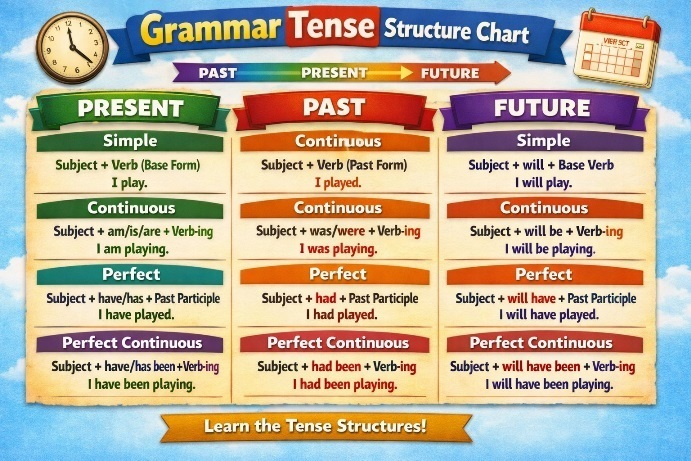
Tenses are the tools we use to track time in English. They act like a clock for our sentences, showing if an action is a current habit, a finished memory, or a future plan. Mastery of tenses is essential for clear communication, storytelling, and academic success in 7th and 8th grades. Whether you are describing your morning routine or predicting the weather, tenses make your meaning precise.
| Time Frame | Meaning | Verb Usage | Example Sentence |
|---|---|---|---|
| Past | Action already happened | Verb in past tense | She visited the museum yesterday. |
| Present | Action happening now / general truth | Verb in present tense | He plays football every evening. |
| Future | Action will happen later | Verb with “will” or “shall” | They will travel to Delhi tomorrow. |
| Past | Completed action | Verb in past tense | I watched a movie last night. |
| Present | Habitual action | Verb in present tense | We eat dinner at 8 PM. |
| Future | Planned action | Verb with “will” | She will join the class next week. |
| Past | Event in history | Verb in past tense | The king ruled for 20 years. |
| Present | Universal truth | Verb in present tense | The sun rises in the east. |
| Future | Prediction | Verb with “will” | It will rain tomorrow. |
A guide to the three main time frames: Past, Present, and Future.
Explanation Step by Step
The form of a verb changes depending on when the action happens. To master tenses, you must follow three steps: First, identify the "time signal" (like 'today' or 'last year'). Second, identify the subject (singular or plural). Third, apply the specific verb ending or auxiliary verb (like 'will' or 'had') required for that time frame.
Sub-topics
1. Present Tense
The Present Tense is used for actions happening right now, regular habits, or universal truths. In real life, we use this to talk about our hobbies or facts like "The earth revolves around the sun."
Examples
Example 1: Regular Habit
Tricky Example: The Universal Truth
2. Past Tense
The Past Tense describes actions that started and finished in the past. We use this when telling stories or reporting a historical event. In real-world shopping, you might say, "I bought this shirt yesterday."
Examples
Example 1: Completed Action
Tricky Example: The 'Did' Rule
3. Future Tense
The Future Tense is used for actions that have not happened yet but will happen later. This is essential for making plans, promises, or predictions about tomorrow's weather or your upcoming exams.
Examples
Example 1: Making a Plan
Tricky Example: Fixed Schedules
Tricks and Shortcuts
- The 'Will' Anchor: For any future action, just anchor the word 'will' before the action word. It never changes for singular or plural subjects!
- Keyword Detective: 'Ago' and 'Yesterday' always point to the Past. 'Now' and 'Always' usually point to the Present.
Common Mistakes
- Double Past Tense: Writing "He didn't went" instead of "He didn't go." Once 'did' is used, the main verb stays simple.
- Third-Person 'S': Forgetting the 's' in Present Tense. It is "She eats," not "She eat."
Practice Questions
Easy Questions
- Identify the tense: "The children play in the park."
- Convert to Past Tense: "I drink orange juice."
- Tricky Real-Life Question: If you are describing your favorite hobby that you do every week, which tense should you use?
Medium Questions
- Change to Future Tense: "Rohan finished his project on time."
- Fill in the blank: "They ________ (to be) at the mall yesterday evening."
- Tricky Real-Life Question: You want to borrow a book tomorrow. Write a sentence to your friend using the Future Tense.
Hard Questions
- Identify the error and rewrite: "She will goes to Mumbai next week."
- Transform "He writes a poem" into all three main tenses (Past, Present, and Future).
- Tricky Real-Life Question: If a shopkeeper says, "The sale ended an hour ago," but you see a sign saying "Sale Starts Tomorrow," write one sentence for each situation using the correct tense.
Revision Summary
Tenses help us navigate through time in English. Present Tense handles habits and facts. Past Tense covers finished business. Future Tense deals with what's coming next. Remember to check your time markers (yesterday, today, tomorrow) and ensure your verbs match the timing of the story you are telling.