Introduction
Contextual meaning refers to the specific meaning of a word based on how it is used in a sentence. A single word can have different meanings depending on the surrounding words and the overall situation described. Understanding context helps us become better readers and communicators.
Explanation Step by Step
To find the contextual meaning of a word, follow these steps:
- Read the entire sentence carefully.
- Look for "clue words" around the unknown word.
- Identify the tone of the sentence (is it happy, sad, or serious?).
- Replace the word with a synonym to see if the sentence still makes sense.
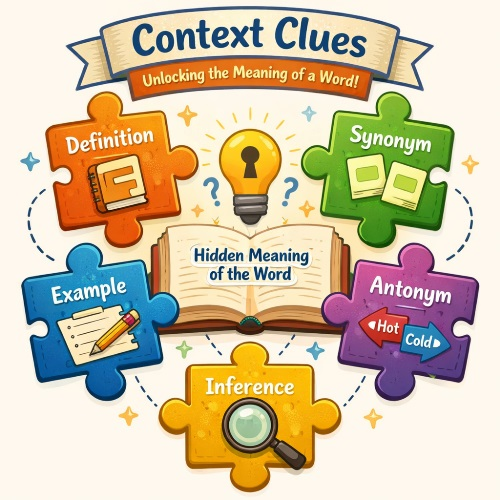
Context clues act like puzzle pieces to reveal the hidden meaning of a word in a specific sentence.
Sub-topics
Vocabulary - Writing contextual meanings of words
In this sub-topic, we focus on interpreting words that have multiple meanings (homonyms) or specific professional meanings within a real-life scenario.
Examples
Example 1 (Real-Life)
Tricky Example (Conceptual)
Tricks and Shortcuts
- The Substitution Trick: Try putting a simple word in place of the hard word. If the sentence works, you've found the meaning!
- Positive/Negative Check: Determine if the word sounds like something good or bad based on the other words in the sentence.
Common Mistakes
- Dictionary Trap: Students often choose the first definition they see in a dictionary without checking if it fits the sentence.
- Ignoring Tone: Sometimes students miss the emotional context, leading to a wrong interpretation of the word.
Practice Questions
Easy Questions
- Real-Life: "I need to record the song on my phone." What does "record" mean here?
- "The bird was light enough to fly." Is "light" referring to color or weight?
- Tricky: "Please close the door." Does "close" mean nearby or to shut something?
Medium Questions
- Real-Life: "The shopkeeper gave me the wrong change after I bought the milk." Define "change."
- "The crane lifted the heavy steel beam to the top of the building." What is a "crane" in this context?
- Tricky: "He had a fair complexion." Does "fair" mean just, or does it describe his skin tone?
Hard Questions
- Real-Life: "The company's stock fell after the news." What does "stock" represent in the business world?
- "The actor made his bow after a brilliant performance." How is "bow" pronounced and what does it mean here?
- Tricky: "The wind was too strong to wind the clock." Explain the two different meanings and pronunciations of "wind" used contextually.
Revision Summary
Contextual meaning is all about being a detective. Don't look at a word in isolation; look at its neighbors. Remember to use the substitution trick and always check the tone of the sentence to ensure the meaning fits perfectly.