📢
Geometry - Point, segment, line, ray, angle (Straight angle, Zero angle, Whole angle, Reflex angle)
Introduction
Geometry is more than just definitions; it is the logic of space. This guide uses structured tables to help you visualize points, lines, and complex rotational angles.
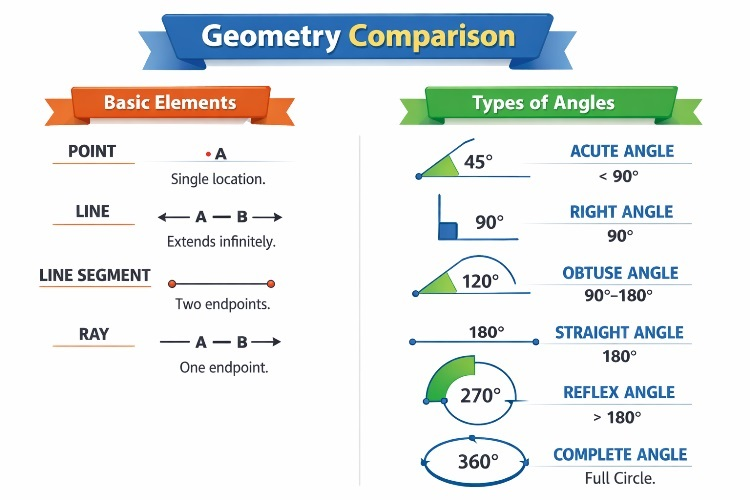
A detailed structural breakdown of geometric entities and rotational angle measurements.
Explanation Step by Step (Tabular)
| Geometric Entity | Defining Characteristics | Dimensionality |
|---|---|---|
| Point | An exact location in space with no length or width. | 0-Dimension. |
| Line Segment | A finite part of a line between two distinct endpoints. | 1-Dimension (Measurable). |
| Ray | Starts at an origin and continues infinitely in one direction. | 1-Dimension (Infinite). |
| Whole Angle | A complete rotation of a ray back to its starting position. | 360 Degrees. |
Sub-topics: Advanced Angles
Complex Rotational Angles
- Zero Angle: Occurs when there is no rotation between two rays.
- Reflex Angle: Represents a rotation greater than a flat line but less than a circle.
- Straight Angle: Formed by two rays pointing in exactly opposite directions.
Examples
Hard Example (Mathematical)
Calculate the angle formed by a ray that rotates 1.5 times around its endpoint.
One full rotation is 360°, and 0.5 rotation is 180°. Total angle = 360° + 180° = 540°. This is beyond a whole angle!
Tricky Example (Real-life)
If you are facing North and turn clockwise to face South-East, what type of angle have you turned through?
Since you turned 135°, it is an Obtuse Angle. However, if you turned counter-clockwise, it would be a Reflex Angle (225°).
Tricks and Shortcuts
- The 'Clock' Rule: Every hour on a clock represents 30 degrees. (360° / 12 hours).
- Reflex Shortcut: To find a reflex angle, subtract the smaller angle from 360°.
Common Mistakes
- Assuming all lines are segments (Remember: Lines cannot be measured).
- Forgetting that a Zero angle and a Whole angle look identical, but represent different amounts of rotation.
Practice Questions
Easy Questions
- How many endpoints does a Ray have?
- What do we call an angle that measures exactly 180°?
- (Tricky) If you place 10 points in a perfect row, do they form a line or a segment?
Medium Questions
- What is the measure of half of a whole angle?
- If an angle is 181°, which category does it fall into?
- (Tricky) Can two rays with different starting points form an angle?
Hard Questions
- A ray rotates 3/4th of a full circle. What is the degree measure and the name of this angle?
- If a clock shows 3:30, what is the exact angle between the hands?
- (Tricky/Real-life) A steering wheel is turned 2 full rotations. How many degrees has it turned in total?
Revision Summary
The transition from a point to a 360° whole angle covers the basics of spatial movement. Always remember: points are positions, lines are paths, and angles are rotations.
If each exterior angle of a polygon is 36°, how many sides does the polygon have?
A
8
B
9
C
10
D
12