Introduction
Non-verbal reasoning focuses on analyzing visual information. In the topic of "Logic and Conclusion" for shapes like cubes, cuboids, triangles, and squares, students must identify patterns, count hidden elements, and visualize 3D objects from 2D nets. This helps in developing spatial intelligence and logical deduction skills without the use of words.
Explanation Step by Step
To master these shapes, we follow a systematic approach. First, identify the basic properties of the shape (sides, vertices, and faces). Second, for counting problems, break the larger figure into smaller, identifiable segments. Third, for cubes and cuboids, understand the relationship between opposite faces when a paper template is folded.
Sub-topics
Counting Triangles and Squares
This sub-topic involves finding the total number of triangles or squares hidden within a complex geometric design. We look for individual small shapes and then combine them to see if they form larger versions of the same shape.
Examples
Example 1
Cubes and Cuboids (Folding and Nets)
This involves visualizing how a flat 2D pattern (a net) turns into a 3D cube. The most important rule is that alternating faces in the net become opposite faces in the cube and can never be adjacent.
Examples
Example 1
Tricks and Shortcuts
For counting squares in an n x n grid, use the formula: 1² + 2² + ... + n². For a 3x3 grid, it is 1 + 4 + 9 = 14.
Common Mistakes
Students often forget to count the largest outer shape or the shapes formed by merging two or more smaller sections.
Practice Questions
Easy Questions
- How many faces does a standard cube have?
- How many vertices are there in a single triangle?
- If a square is divided by one diagonal, how many triangles are formed?
Medium Questions
- Find the number of squares in a 4x4 grid.
- In a net of a cube, if the top face is '1', which face is at the bottom? (Assume standard numbering).
- Count the number of triangles in a square with both diagonals drawn.
Hard Questions
- A cube is painted red on all sides and cut into 27 small cubes. How many small cubes have only two sides painted?
- A complex figure consists of a large triangle with three horizontal lines and one vertical line. Count the total triangles.
- Determine the opposite face of a specific number in a non-standard dice net provided in a diagram.
Revision Summary
Focus on systematic counting, understand the formula for grids, and remember that opposite faces in a cube net never share an edge.
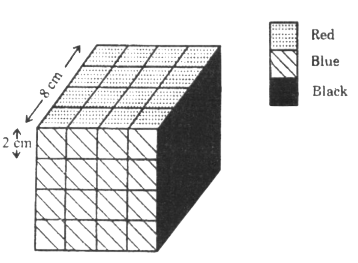
How many cubes have no side painted?