Introduction
Classification involves grouping elements based on common properties. In "Classification - Numbers," you are given a set of four numbers. Three numbers share a specific mathematical relationship, while one is different. Your task is to identify this "Odd One Out."
Explanation Step by Step
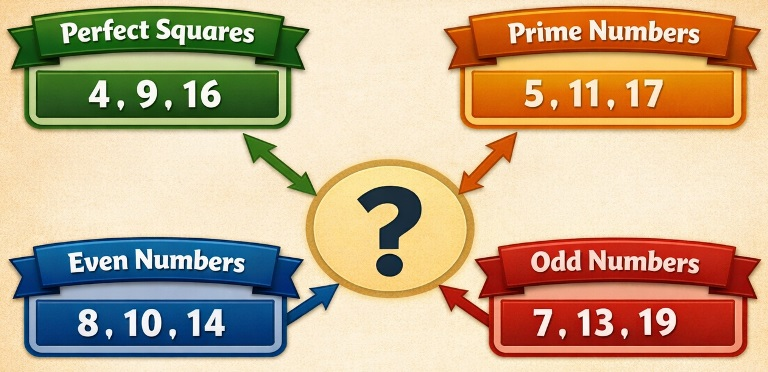
To solve these questions, analyze the numbers using these criteria:
- Prime vs. Composite: Check if numbers have only two factors or more.
- Even vs. Odd: Look at the divisibility by 2.
- Powers: Check if they are perfect squares or cubes.
- Divisibility: Apply divisibility rules for 3, 7, 9, 11, etc.
- Digit Operations: Sum of digits or product of digits logic.
Sub-topics
Classification - Numbers
Mastering the identification of numerical patterns.
Examples
Example 1
Tricks and Shortcuts
Always check for Prime numbers first, then Squares/Cubes, and then Divisibility rules. This hierarchy often leads to the correct answer faster.
Common Mistakes
Don't rely on simple "large vs. small" logic. Always look for a mathematical property that connects three out of four numbers.
Practice Questions
Easy Questions
- 1) 22, 2) 44, 3) 66, 4) 77
- 1) 9, 2) 25, 3) 49, 4) 50
- 1) 2, 2) 4, 3) 6, 4) 9
Medium Questions
- 1) 11, 2) 13, 3) 15, 4) 17
- 1) 64, 2) 125, 3) 216, 4) 350
- 1) 26, 2) 37, 3) 50, 4) 63
Hard Questions
- 1) 121, 2) 143, 3) 165, 4) 186
- 1) 7, 2) 26, 3) 63, 4) 124
- 1) 392, 2) 512, 3) 288, 4) 200
Revision Summary
Classification tests your number sense. Focus on prime numbers, squares, and divisibility patterns to excel.