Introduction
Comprehension of language involves analyzing word structures, identifying the number of letters, and understanding how compound letters are formed. This skill helps in building a strong vocabulary and solving linguistic puzzles.
Explanation Step by Step
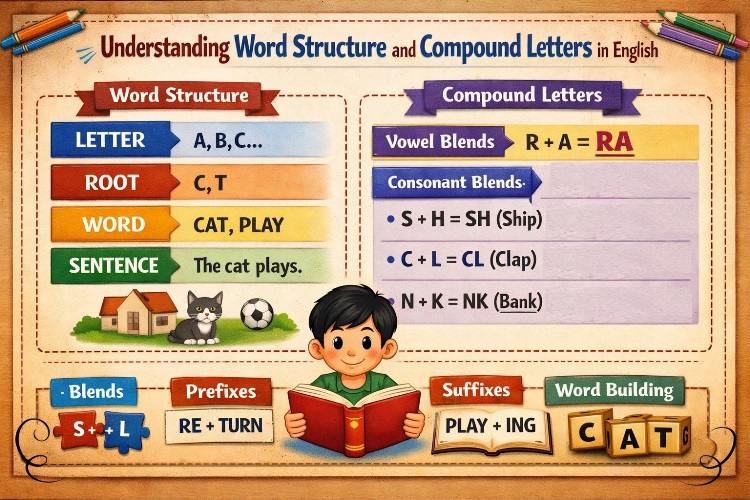
To master this topic, one must observe words carefully. Focus on identifying specific letters, counting their occurrences, and distinguishing between simple and compound characters.
Comprehension - Knowledge of language
This subtopic focuses on breaking down a given word into its basic components to understand its structure.
Examples
Example 1
Tricks and Shortcuts
Always check if a letter repeats in a word. When asked to form new words, ensure you only use the letters available in the primary word provided.
Common Mistakes
Students often miscount letters when vowels and consonants are blended in complex ways. In Indian languages, confusing a vowel-blend (like 'Ru') with a compound letter is a frequent error.
Practice Questions
Easy Questions
- Identify the third letter in the word "SUCCESS".
- How many vowels are present in the word "APPLE"?
- Can the word "BAT" be formed using the letters from "TABLET"?
Medium Questions
- How many times does the letter "O" appear in the word "COOPERATION"?
- Identify the middle letter of the word "LANGUAGE".
- Which meaningful 3-letter word can be formed using the 2nd, 4th, and 5th letters of the word "STATION"?
Hard Questions
- Rearrange the letters "A, T, R, E, W" to form a meaningful word related to nature.
- Count the total number of consonants in the phrase "KNOWLEDGE IS POWER".
- In the word "TRANSFORMATION", which letter appears exactly twice?
Revision Summary
Focus on careful observation of each letter. Remember that word formation depends strictly on the set of letters provided in the original word.