Introduction
Puzzle-based questions test logical reasoning by using overlapping geometric shapes to represent data sets.
Explanation Step by Step
In these puzzles, shapes like rectangles, triangles, squares, and circles are interconnected. Each shape represents a specific category. Numbers or symbols placed within these intersections provide specific information about the groups.
Sub-topics
Venn diagram
Solving Venn diagram puzzles requires careful observation to identify numbers belonging to specific, overlapping, or exclusive regions.
Examples
Example 1
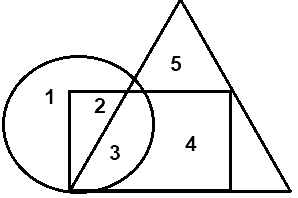
Question: Which number is found only in the triangle?
Step 1: Observe the boundary of the triangle.
Step 2: Find the number that is not in the circle or the square.
Answer: 5
Tricks and Shortcuts
Focus on keywords like 'Only', 'At least', and 'Both'. The word 'Only' strictly excludes all other overlapping shapes.
Common Mistakes
Ignoring the boundary of one shape while focusing on another leads to incorrect identification of shared regions.
Practice Questions
Easy Questions
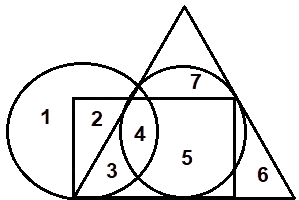
- In the given figure, how many circles intersect each other?
- Which number is common to both the triangle and the circle?
Medium Questions
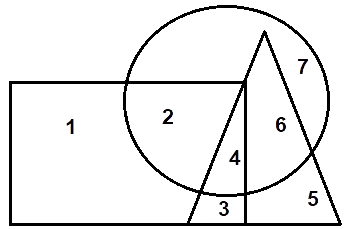
- How many elements are present in both the triangle and the rectangle, but not in the circle?
- Find the single number that is present in all three figures: the square, the triangle, and the circle.
- What is the total count of numbers that are present only in the circle?
Hard Questions
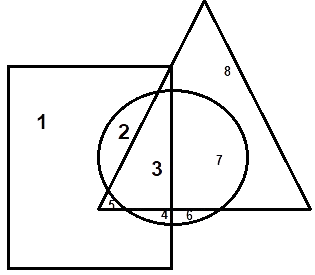
- Calculate the sum of all the numbers that appear in at least two figures.
- If the numbers inside the circle are doubled, what would be the new sum in the region common to the triangle and the circle?
Revision Summary
Success in Venn puzzles comes from identifying exclusive versus shared areas through systematic observation.
Out of 200 persons 90 persons like tea, 108 persons like coffee and 46 persons like both tea and coffee. How many persons do not like either tea or coffee?
Woman, Gynecologist, Doctor


