Introduction
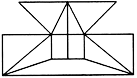
Logic and Inference involves testing the ability to analyze visual information. In non-verbal reasoning, we focus on identifying patterns and counting geometric shapes within complex figures to draw accurate conclusions.
Explanation Step by Step
The core concept involves breaking down a complex figure into its fundamental parts. By observing the structure carefully, one can use logical formulas or systematic counting to find the total number of shapes like triangles or blocks.
Sub-topics
Non-verbal: Triangle
Counting triangles is a fundamental part of logic. It requires identifying single triangles and those formed by combining multiple smaller units.
Examples
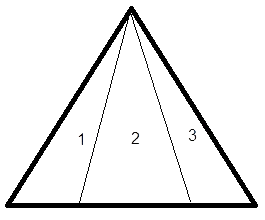
Example 1: Counting Intersecting Triangles
Tricks and Shortcuts
For counting triangles in a square with diagonals: Count the smallest triangles and multiply by 2.
Common Mistakes
Ignoring the outermost boundary shape as a single large unit is a frequent error.
Practice Questions
Easy Questions
- If the two diagonals of a square are drawn, how many triangles will be formed in total?

- If there are three horizontal lines within a large triangle, how many triangles will be formed in total?
Medium Questions
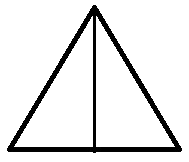
- If there are three horizontal lines within a large triangle, how many triangles will be formed in total?
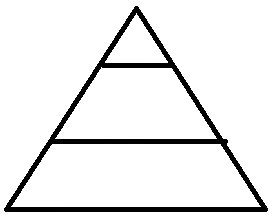
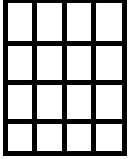
- What is the total number of quadrilaterals in the figure given below?
Hard Questions
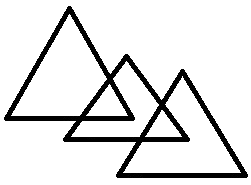
- How many triangles are formed in a figure consisting of three interwoven triangles?
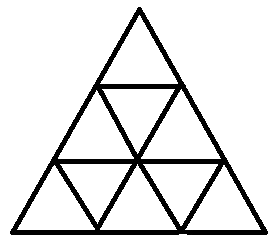
- How many triangles are there in total?
Revision Summary
Systematic observation and using numbering techniques are essential for solving logic and inference problems accurately.