Introduction
The calendar is a fundamental tool for organizing time. In competitive exams, calendar puzzles involve finding the day of the week for a given date. Understanding the structure of years, months, and weeks is essential for solving these logic-based problems efficiently.
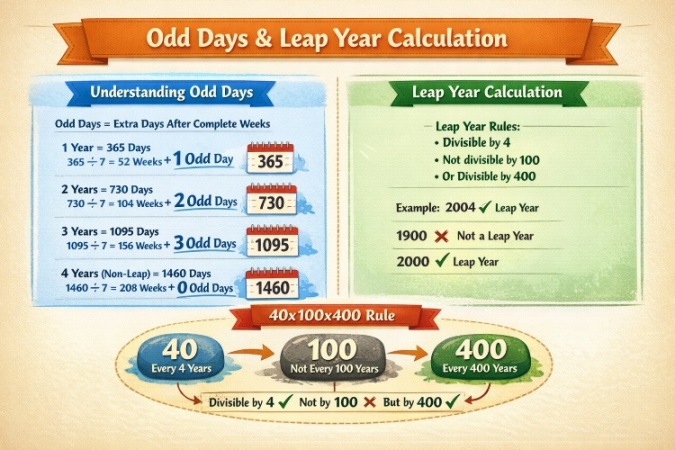
Diagram explaining Odd Days and Leap Year calculation methods.
| Date | Importance of the Day |
|---|---|
| 26 January | Republic Day |
| 1 May | Maharashtra Day / Labour Day |
| 15 August | Independence Day |
| 5 September | Teachers' Day |
| 2 October | Gandhi Jayanti |
| 14 November | Children's Day |
Memorizing these fixed dates helps in solving "day calculation" problems without needing to check a physical calendar.
Explanation Step by Step
A standard year consists of 365 days, which equals 52 weeks and 1 odd day. A leap year has 366 days, resulting in 2 odd days. To find the day on the same date in the following year, we jump 1 day forward for a normal year and 2 days for a leap year if February 29 is crossed.
Sub-topics
Puzzles and Brain Teasers - Calendar
This subtopic covers identifying leap years, counting odd days between two dates, and calculating the repetition of calendar months.
Examples
Example 1
Tricks and Shortcuts
The "Odd Days" method is the fastest: Total days divided by 7 gives the remainder, which indicates how many days to move forward. Remember that years divisible by 400 are always leap years.
Common Mistakes
Students often forget to check if the specific period crosses February 29. If you are calculating from January 2024 to January 2025, you must add 2 days because 2024 is a leap year.
Practice Questions
Easy Questions
- If 1 January 2025 is Wednesday, what day will it be on 31 December 2025?
- How many odd days are there in a standard year of 365 days?
- If today is Sunday, what day was it 7 days ago?
Medium Questions
- How many days are there from 26 January to 15 August in a non-leap year?
- If 12 March is a Monday, what will be the day on 12 April of the same year?
- Which day occurs 5 times in a month of 30 days that starts on a Friday?
Hard Questions
- If 1 January 2000 was a Saturday, what day of the week was 1 January 2001?
- A boy was born on 29 February 2012. By 2025, how many birthdays will he have celebrated on the actual date?
- If the day before yesterday was Saturday, what day will it be 5 days after tomorrow?
Revision Summary
Mastering the concept of 7-day remainders and distinguishing between solar years and leap years is the key to solving any calendar-related brain teaser.