Introduction
Position in a queue is a fundamental topic in logical reasoning. It involves calculating the total number of people in a line or finding a specific person's rank from either end. These problems test your ability to visualize spatial arrangements and apply mathematical logic to everyday scenarios like ticket counters or classroom rows.
Explanation Step by Step
There are two types of arrangements: horizontal (left-right) and vertical (front-back). The core principle is that when a person's position is given from both ends, they are being counted twice. Therefore, to find the total, we add both positions and subtract 1. If the total is odd, there is exactly one person in the middle.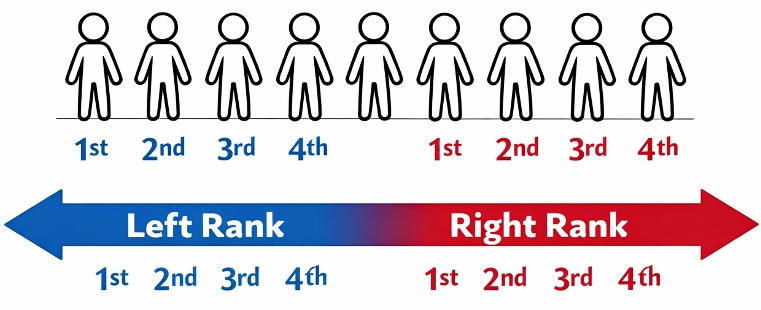
Visual representation of calculating total strength from dual-end rankings.
Sub-topics
Puzzles and Brain Teasers - Position in a Queue
This sub-topic covers finding the middle rank, total distance between objects like poles or trees, and the relationship between cuts and pieces in a linear object.
Examples
Example 1
Tricks and Shortcuts
* Total Strength = (Rank from Start + Rank from End) - 1.
* Middle Rank = (Total + 1) / 2.
* Total Distance = (Total number of objects - 1) x Distance between two adjacent objects.
Common Mistakes
The most common error is forgetting to subtract 1 when calculating the total from both ends. Another mistake is assuming the number of cuts is equal to the number of pieces; remember, pieces are always one more than the cuts.
Practice Questions
Easy Questions
- If Rohan is 7th from both ends of a queue, how many people are there in total?
- In a row of 15 children, what is the rank of the child standing exactly in the middle?
- How many cuts are needed to divide a long ribbon into 10 equal pieces?
Medium Questions
- In a class of 50 students, Maya's rank is 21st from the top. What is her rank from the bottom?
- There are 6 poles fixed at an equal distance of 5 meters from each other. What is the distance between the first and the last pole?
- In a row, Amit is 10th from the front and there are 5 students behind him. How many students are in the row?
Hard Questions
- The person in the middle of a queue is at the 26th position. How many people are there in the queue?
- It takes 12 minutes to cut a wooden log into 4 pieces. How much time will it take to cut it into 8 pieces?
- In a row of 40 girls, when Neha was shifted to her left by 4 places, her number from the left end became 10th. What was her original number from the right end?
Revision Summary
Master the formulas for total count and middle position. Always visualize the queue to ensure you aren't overcounting or undercounting the positions.