Introduction
Modal auxiliaries are special helping verbs that provide additional meaning to the main verb in a sentence. They express ideas like ability, possibility, permission, obligation, and necessity. Unlike regular verbs, they do not change their form based on the subject.
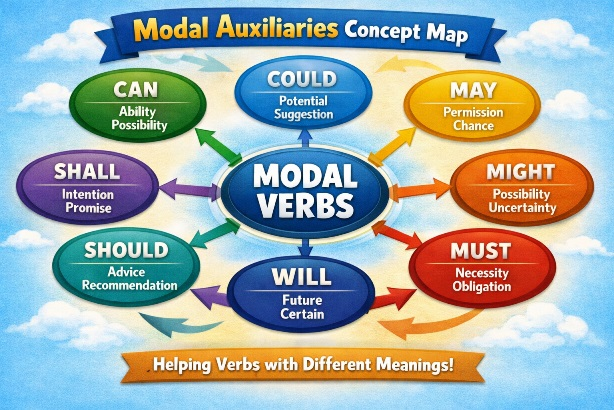
| Modal Auxiliary | Function / Use | Example Sentence |
|---|---|---|
| Can | Shows ability or possibility | I can swim fast. |
| Could | Shows past ability or polite request | Could you help me? |
| May | Expresses permission or possibility | You may go now. |
| Might | Shows a weaker possibility | It might rain today. |
| Must | Expresses necessity or strong obligation | You must wear a seatbelt. |
| Shall | Used for future or formal suggestion | We shall overcome. |
| Should | Expresses advice or expectation | You should study harder. |
| Will | Shows future intention or willingness | I will call you tomorrow. |
| Would | Used for polite requests or hypothetical situations | Would you like some tea? |
| Ought to | Expresses moral duty or advice | You ought to respect elders. |
| Need to | Shows necessity or requirement | You need to finish your homework. |
| Dare | Expresses courage or challenge | He dare not speak loudly. |
| Can’t | Shows impossibility or prohibition | You can’t park here. |
| Shouldn’t | Expresses disapproval or warning | You shouldn’t lie. |
| May not | Denies permission | You may not enter the room. |
| Might have | Shows past possibility | He might have missed the bus. |
| Must have | Shows strong past certainty | She must have left early. |
| Would have | Shows unreal past condition | I would have helped if I knew. |
| Could have | Shows missed opportunity | We could have won the game. |
Explanation Step by Step
Modal auxiliaries are used before the base form of a main verb. For example, in "I can swim," 'can' is the modal auxiliary and 'swim' is the main verb. They are essential for polite conversation, giving advice, and predicting future events.
Sub-topics
Language Study - Modal Auxiliaries
Different modals serve different functions. 'Can' and 'Could' represent ability. 'May' and 'Might' represent possibility or permission. 'Must' and 'Have to' represent necessity. 'Should' is used for advice.
Examples
Example 1: Ability
Example 2: Real-Life Situation (Permission)
Tricky Example: Possibility vs. Ability
Tricks and Shortcuts
- The "No-S" Rule: Never add 's', 'es', or 'ing' to a modal. It is always "He can," never "He cans."
- Base Form Only: Always use the root verb after a modal. Example: "You should go" (not "to go" or "going").
Common Mistakes
- Using "to" after Modals: Students often say "I must to go." Correct: "I must go."
- Confusing 'Can' and 'May': In formal settings, use 'May' for permission. 'Can' is strictly for ability or informal use.
Practice Questions
Easy Questions
- Identify the modal auxiliary: "You should eat your vegetables."
- Fill in the blank for ability: "I ___ speak three languages fluently."
- Tricky Question: Which sentence is correct? (A) She can sings. (B) She can sing.
Medium Questions
- Rewrite for politeness: "Give me that book." (Use 'Could')
- Real-life Scenario: Your friend is feeling sick. Give him advice using a modal.
- Tricky Question: Fill with a modal showing 100% necessity: "Students ___ wear uniforms to school."
Hard Questions
- Explain the difference in meaning: "I might go to the party" vs "I must go to the party."
- Real-life Scenario (Tricky): You see a "No Parking" sign. Use a modal to explain the rule to a driver.
- Tricky Question: Rewrite the sentence using a modal of 'logical deduction': "I am certain that is the Principal's car."
Revision Summary
Modal auxiliaries like can, should, and must add specific "moods" to actions. They never change their spelling and are always followed by a base verb. Use them to express ability, necessity, or permission in your daily English communication.