Introduction
Geometry involves the study of shapes and spaces. While flat shapes like squares and circles are two-dimensional, objects in the real world have depth, making them three-dimensional (3D). Understanding how these objects are formed from flat layouts, called nets, is essential for mastering spatial geometry.
Explanation Step by Step
A three-dimensional object occupies space and has three measurements: length, width, and height. A net is a two-dimensional skeleton or pattern that can be folded to create a specific 3D shape.
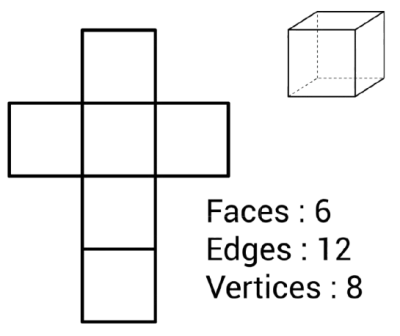
A 2D net folding into a 3D cube
Sub-topics
Geometry - Three-dimensional objects and Nets
Common 3D objects include cubes, cuboids, cylinders, and pyramids. Each has a unique net consisting of faces, edges, and vertices.
Examples
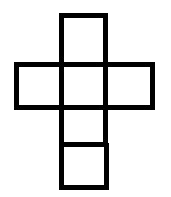
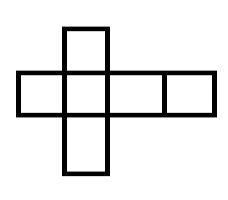
Example 1: The Cube
Tricks and Shortcuts
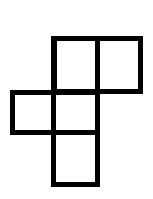
To identify a cube's net, look for 6 squares arranged such that no four squares meet at a single point, and they can fold without overlapping.
Common Mistakes
Students often forget that a net must have the exact number of faces required for the 3D shape. For example, a cube net with only 5 squares cannot form a complete cube.
Practice Questions
Easy Questions
- How many faces does a standard cube have?
- What is a two-dimensional pattern used to make a 3D object called?
- True or False: A cuboid has 6 rectangular faces.
Medium Questions
- How many edges are found in a three-dimensional cuboid?
- Describe the shape of the faces in a net of a cylinder.
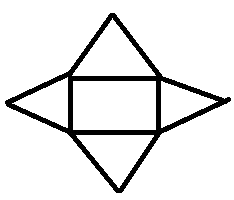
- If a net has 4 triangles and 1 square base, which 3D object does it form?
Hard Questions
- Explain why a net with 7 squares cannot be the net of a single cube.
- A net consists of two circles and one rectangle. Visualize and name the 3D object.
- Compare the vertices and edges of a cube and a square pyramid.
Revision Summary
3D objects have length, width, and height. Nets are the 2D shapes that fold into these objects. Cubes have 6 square faces, while cuboids have 6 rectangular faces.