Operations on numbers - L.C.M., G.C.D
Introduction
G.C.D. (Greatest Common Divisor) and L.C.M. (Least Common Multiple) are essential tools for simplifying fractions and solving timing-based word problems. G.C.D. is the largest factor common to all, while L.C.M. is the smallest common multiple.
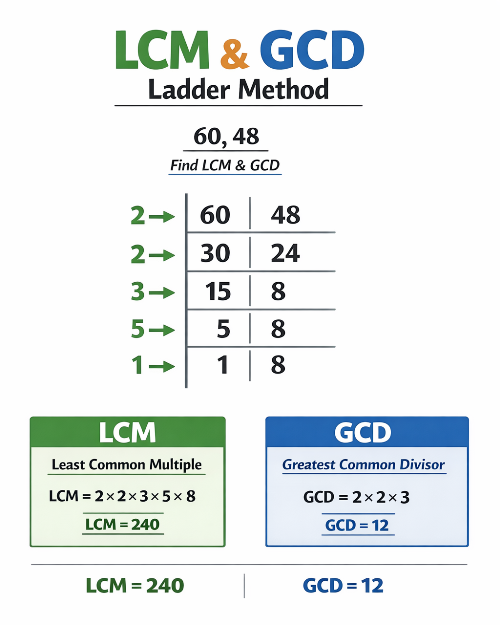
Using the ladder method (synthetic division) is the fastest way to find both LCM and GCD together.
Quick Table Trick (Numbers: 12, 18)
| Divisor | 12 | 18 | Action |
|---|---|---|---|
| 2 | 6 | 9 | Divides both (Keep for GCD) |
| 3 | 2 | 3 | Divides both (Keep for GCD) |
| 2 | 1 | 3 | Divides only one |
| 3 | 1 | 1 | Divides only one |
GCD: Multiply bold divisors (2 × 3) = 6
LCM: Multiply all divisors (2 × 3 × 2 × 3) = 36
Sub-topics
Operations on numbers - L.C.M., G.C.D
Examples
Tricky Example
What is the G.C.D. of any two prime numbers?
Answer: 1. Because prime numbers only have 1 and themselves as factors.
Common Mistakes
1. Confusing 'multiple' (larger) with 'divisor' (smaller).
2. Forgetting that GCD of co-prime numbers is always 1.
Practice Questions
Easy Questions
- Find GCD of 16 and 24.
- Find LCM of 5 and 12.
- Tricky: If GCD of two numbers is 7, can the numbers be 14 and 21?
Medium Questions
- Product of two numbers is 150. If LCM is 30, find GCD.
- Find LCM of 10, 20, and 30.
- Tricky: Find GCD of 100 and 101.
Hard Questions
- Find the smallest number which leaves a remainder 5 when divided by 20 and 30.
- Ratio of two numbers is 2:3. If LCM is 54, find the numbers.
- Tricky: Can the LCM of two numbers be smaller than their GCD? Why?
Revision Summary
GCD is the highest shared factor. LCM is the lowest shared multiple. Product = GCD × LCM.
The product of two 2-digit numbers is 2400 and their LCM is 6 times their HCF. What is the difference between these two numbers?
Explanation
Formula: Product of two numbers = HCF * LCM 2400 = HCF * (6 * HCF) 2400 = 6 * (HCF)² (HCF)² = 2400 / 6 = 400 HCF = 20
Since HCF = 20, LCM = 6 * 20 = 120.
Product of uncommon factors = LCM / HCF = 120 / 20 = 6.
Coprime factor pairs for 6 are (2, 3).
Find the numbers by multiplying factors with HCF:
First number = 2 * 20 = 40
Second number = 3 * 20 = 60 Both 40 and 60 are 2-digit numbers, which fits the condition.
Difference between the numbers = 60 - 40 = 20. Wait, let's recheck the options layout. Difference is 20, option b. Let's fix the choice marker. = 20
Since HCF = 20, LCM = 6 * 20 = 120.
Product of uncommon factors = LCM / HCF = 120 / 20 = 6.
Coprime factor pairs for 6 are (2, 3).
Find the numbers by multiplying factors with HCF:
First number = 2 * 20 = 40
Second number = 3 * 20 = 60 Both 40 and 60 are 2-digit numbers, which fits the condition.
Difference between the numbers = 60 - 40 = 20. Wait, let's recheck the options layout. Difference is 20, option b. Let's fix the choice marker. = 20
Like
0
Correct
2
Wrong
17