Introduction
Mathematical puzzles are problems that require mathematical logic and reasoning to solve. Unlike standard math equations, these puzzles often hide a pattern or a rule that you must discover. They help in developing critical thinking and improving numerical fluency for competitive exams.
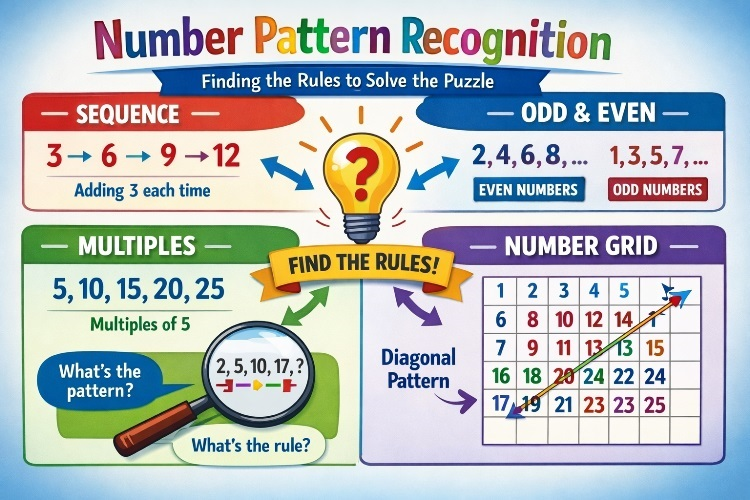
Identifying patterns between numbers is the key to solving mathematical puzzles.
Explanation Step by Step
To solve a math puzzle, first identify the relationship between the given numbers. Look for operations like addition, subtraction, multiplication, or division. Check if squares or cubes are involved. Apply the discovered rule to the final set of numbers to find the missing value.
Sub-topics
Puzzles and Brain Teasers - Mathematical Puzzles
This involve number series, grid-based puzzles, and missing character problems where logic dictates the placement of numbers.
Examples
Example 1
Tricks and Shortcuts
Look for the difference between consecutive numbers. If the difference increases rapidly, multiplication or squares might be involved.
Common Mistakes
Avoid assuming a pattern based on only the first two numbers. Always verify the rule with at least three examples in the puzzle.
Practice Questions
Easy Questions
- Complete the series: 10, 20, 30, 40, ?
- If 1=3, 2=6, 3=9, then 4=?
- Find the odd one out: 2, 4, 6, 9, 10.
Medium Questions
- If 2 + 2 = 5, 3 + 3 = 7, then 4 + 4 = ?
- What is the next number in the sequence: 1, 4, 9, 16, 25, ?
- A clock strikes once at 1 o'clock, twice at 2 o'clock, and so on. How many times does it strike in 12 hours?
Hard Questions
- Solve the missing number in a 3x3 grid: Top row (2, 3, 13), Middle row (4, 5, 41), Bottom row (6, 7, ?).
- If 111 = 13, 112 = 24, 113 = 35, then 117 = ?
- A father is 4 times as old as his son. In 20 years, he will be twice as old as his son. Find their current ages.
Revision Summary
Focus on identifying patterns like arithmetic progression, geometric growth, and squares. Practice daily to improve speed and accuracy.