Introduction
Correlation in the English alphabet is an important reasoning topic. In this type of question, relationships between letters are analyzed based on their positions in the alphabet. Students must identify the pattern between one pair and apply it to another pair.
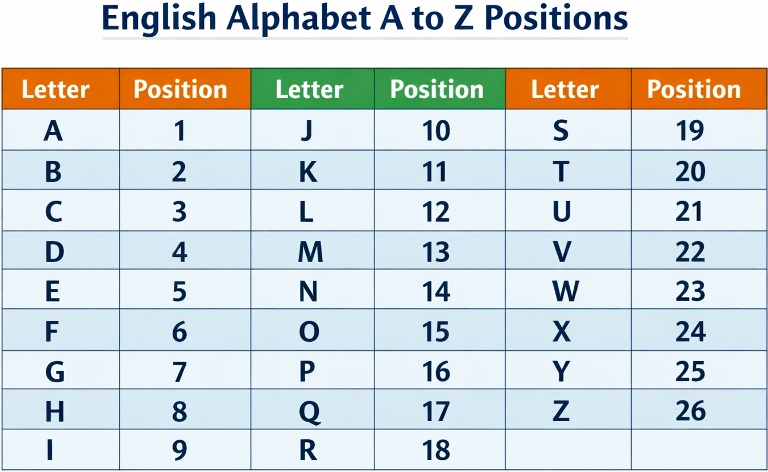
Explanation Step by Step
The English alphabet has 26 letters. Each letter has a fixed position. For example, A = 1, B = 2, C = 3, and so on up to Z = 26. In correlation questions, patterns may involve shifting letters forward or backward, or using numerical operations like addition or subtraction.
First, observe the relationship in the given pair. Then apply the same rule to find the missing pair. Careful observation is the key.
Sub-topics
Correlation - English alphabet
This subtopic focuses on identifying patterns like letter shifting, positional differences, and numerical relationships between letters.
Examples
Example 1
Tricks and Shortcuts
Write the position of each letter below it. This helps you identify patterns quickly. Always remember A = 1 and Z = 26.
Common Mistakes
Students often miscalculate positions or skip letters incorrectly. Another common mistake is not applying the same rule consistently.
Practice Questions
Easy Questions
- AB : CD :: EF : ?
- MN : OP :: QR : ?
- GH : IJ :: KL : ?
Medium Questions
- AZ : BY :: CX : ?
- CF : IL :: JM : ?
- BD : FH :: JL : ?
Hard Questions
- ACE : GIK :: MOQ : ?
- BDF : HJL :: NPR : ?
- AZB : YXC :: WVU : ?
Revision Summary
Alphabet correlation problems require understanding letter positions and patterns. Practice regularly and focus on identifying relationships quickly.