Introduction
Parallel lines are lines in a plane that never meet, no matter how far they are extended. Imagine railway tracks; they stay at the same distance from each other throughout. When a third line, called a transversal, intersects these parallel lines, it creates several interesting angles with unique properties.
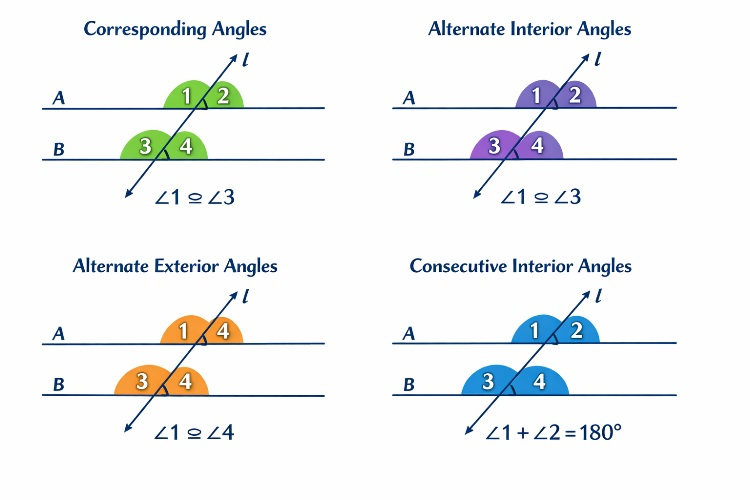
Parallel lines intersected by a transversal line creating various angle relationships.
Explanation Step by Step
When two parallel lines are cut by a transversal, we identify three main types of angle pairs: Corresponding angles (which are equal), Alternate angles (which are equal), and Interior angles on the same side (which add up to 180 degrees).
Sub-topics
Geometry - Properties of parallel lines
Parallel lines maintain a constant perpendicular distance. The transversal creates 8 angles in total. Corresponding angles occupy the same relative position at each intersection. Alternate interior angles are on opposite sides of the transversal between the two lines. Interior angles on the same side are supplementary.
Examples
Example 1: Real-life Window Grill
A window has 2 parallel horizontal bars. A vertical decorative rod (transversal) crosses them. If the top-right angle is 70°, find the bottom-right angle.
Tricky Example: The Zig-Zag Path
Two parallel roads are connected by a diagonal path. If one interior angle is 110°, what is its consecutive interior angle on the same side?
Tricks and Shortcuts
1. The "F" Shape: Look for the letter F; the angles inside the corners of the F are Corresponding Angles and they are equal.
2. The "Z" Shape: Look for the letter Z; the angles inside the corners of the Z are Alternate Interior Angles and they are equal.
Common Mistakes
1. Assuming all angles are equal: Only specific pairs are equal. Remember that interior angles on the same side add up to 180°, they are not equal!
2. Non-parallel lines: Students often apply these rules to any two lines. These properties only work if the lines are strictly parallel.
Practice Questions
Easy Questions
- If two lines are parallel, how many times will they intersect? (Real-life context: Think of a ladder's steps).
- In a parallel line diagram, if one corresponding angle is 50°, what is the measure of the other?
- Tricky Question: Can a transversal be perpendicular to the parallel lines? If yes, what is the angle?
Medium Questions
- Two interior angles on the same side of a transversal are in the ratio 2:3. Find the measure of both angles.
- A carpenter is making a table with parallel legs. If the transversal brace makes an alternate interior angle of 45°, what is the other alternate interior angle?
- Tricky Question: If a transversal intersects two lines and the corresponding angles are not equal, what can you conclude about the lines?
Hard Questions
- In a complex city map, Road A is parallel to Road B. A third road cuts both. If the exterior alternate angle is (3x + 10) and its partner is (2x + 40), solve for x.
- Real-life: A solar panel is mounted on parallel brackets. If the angle of the sun (transversal) creates an interior angle of 120° on one side, what is the measure of the interior angle on the same side?
- Tricky Question: If line L is parallel to M, and M is parallel to N, is L parallel to N? Explain why using transversal properties.
Revision Summary
Parallel lines never touch. A transversal creates equal corresponding and alternate angles. Interior angles on the same side are supplementary (180°). Look for F and Z shapes to identify angles quickly.