Introduction
Number series is a fundamental part of competitive intelligence testing. It involves a sequence of numbers following a specific logical rule or mathematical formula. The objective of "Logic and Conclusion" in number series is to decode the hidden pattern between consecutive terms to find missing values. Mastering this topic enhances a student's numerical fluency, pattern recognition skills, and logical reasoning abilities. To excel, students must be familiar with basic arithmetic operations and special number categories like primes, squares, and cubes.
Explanation Step by Step
To identify the formula in a number series, follow these steps: First, observe the trend—is the series increasing, decreasing, or alternating? Second, calculate the difference between adjacent terms. If the difference is constant, it is an arithmetic series. Third, if the growth is rapid, check for multiplication or powers (squares/cubes). Fourth, if no simple rule fits, check the "difference of differences" or look for combined operations like (number × 2) + 1. Finally, verify your identified formula across the entire series to ensure consistency.
Sub-topics
Logic and Conclusion - To identify formulae in Number Series
This sub-topic focuses on categorizing series based on their mathematical structure. Common types include Addition/Subtraction series, Product series, Square/Cube series, and Mixed operator series. Identifying the correct category is the first step toward finding the formula.
Examples
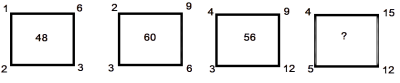
Example 1
Tricks and Shortcuts
Always check the difference first. If the series is stagnant or decreasing, look for subtraction or division. Memorize squares up to 30 and cubes up to 15 to spot patterns instantly. If a series has many terms, it might be an alternating series combining two different rules.
Common Mistakes
The most common mistake is jumping to a conclusion after checking only the first two terms. Always validate the pattern with the third and fourth terms. Another mistake is ignoring prime numbers, which often appear in series but don't follow standard gap rules.
Practice Questions
Easy Questions
- Identify the next number in the series: 11, 22, 33, 44, ?
- Complete the subtraction series: 50, 45, 40, 35, ?
- Find the missing term: 2, 4, 6, 8, ?, 12
Medium Questions
- Identify the formula and find the next term: 1, 8, 27, 64, ?
- What comes next in the series: 2, 5, 11, 23, ? (Hint: Multiply by 2 and add 1).
- Find the missing number: 7, 10, 15, 22, ?
Hard Questions
- Solve the series: 2, 12, 36, 80, 150, ?
- Find the next term: 0, 7, 26, 63, ? (Hint: n³ - 1).
- Identify the pattern in the following mixed series: 5, 6, 14, 45, ?
Revision Summary
Formula identification requires observing the rate of change. Arithmetic series use addition/subtraction, while exponential series use squares/cubes. Always verify your pattern till the end of the sequence.